William Grant presents thesis on Nitrate Contributions to the Niantic River Estuary

Tata & Howard Engineer William Grant presenting his thesis

Recently, Tata & Howard Engineer and recent University of Connecticut graduate William Grant presented his senior thesis. Working with the Niantic River Nitrogen Work Group, William conducted research to evaluate the concerning nitrate contributions to the Niantic River Estuary from the Cranberry Meadow Brook and the Latimer Brook. The excess of nitrogen in the estuary has become a serious threat to aquatic life, causing eutrophication and hypoxia. It was determined, using a two endmember temperature mixing model, that Cranberry Meadow Brook contributes 33% of the total flow of water to the Lower Branch of the Latimer Brook, and the Upper Branch of the Latimer Brook contributes 67% of the total flow. Although the Cranberry Brook is much smaller and contributes less flow of water to the Lower Branch of the Latimer Brook, it contributes equal amounts of nitrate to the Latimer Brook system. William concluded, based on qualitative analysis on land cover and land use, that the high level of nitrate from the Cranberry Meadow Brook is a result of agriculture runoff and ground water inputs. His research will greatly help scientists and other engineers as they try to reduce the severe eutrophication and hypoxia that are hazardous to aquatic life in the Niantic River Estuary.

Employee Health & Fitness Month 2016 Wrap-Up

May was National Employee Health & Fitness Month. At Tata & Howard, we are not only committed to engineering a healthy environment, we are also committed to improving our personal health. Therefore, we celebrated National Employee Health & Fitness Month with a series of weekly initiatives, which were announced on Monday of each week. We kicked off National Employee Health & Fitness Month with a Steps Challenge where we challenged all employee-owners to walk 100 miles in the month of May – that’s 200,000 steps total — to be entered to win a FitBit Blaze. We also introduced a “Smarter Choices” section to our snacks in the kitchen and went for a mid-day walk.

Waterbury, CT team members stopped during their mid-day walk to examine some newly hatched tadpoles
T&H's Gratitude Bowl
T&H’s Gratitude Bowl

Since health goes beyond the physical, employee-owners were challenged to write down their “gratitudes” and drop them into the Gratitude Bowl for week two of the challenge. Team members were also encouraged to thank their fellow co-workers. Week three’s challenge asked employee-owners to eat more fruit, and the company provided fruit to all employees to help get them started. For week four, team members were challenged to (surprise!) drink more water. Each team member received a T&H water bottle with verbiage that encourages them to refill with tap water.

Engineers in the Marlborough office pose with their T&H water bottles

The month of activities culminated with an after-work 5K on June 1, National Running Day, and with Meagan Heslin being drawn as the winner of the FitBit Blaze for completing the step challenge. Congratulations to the whole team for rising up to the challenge of improving health and fitness!

Karen Gracey high fives FitBit Blaze winner Meagan Heslin

2016 Small MS4 Stormwater Permit for Massachusetts and Stormwater Collaboratives Workshop a Huge Success

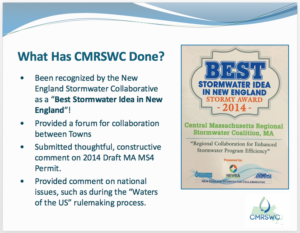
Screen Shot 2016-05-19 at 2.42.04 PMOn Wednesday, May 18, 2016, the Association to Preserve Cape Cod (APCC), the Barnstable Coastal Resources Committee, the Cape Cod Commission, and the Massachusetts Bays National Estuary Program hosted a free workshop entitled “2016 Small MS4 Stormwater Permit for Massachusetts and Stormwater Collaboratives.” The event, which was very well attended, was held at Cape Cod Community College and featured several presentations, including the keynote by Mr. Newton Tedder, MS4 Program, Region 1, US EPA, on “2016 Final Massachusetts Small MS4 General Permit for Stormwater.” Mr. Tedder, a key contributor to the revised permit, was available for questions. Also presenting at the workshop were Tata & Howard’s Stormwater Manager Jon Gregory, P.E., and Cherry Valley & Rochdale Water District Superintendent Michael Knox. Both Jon and Mike presented on the Central Massachusetts Regional Stormwater Coalition (CMRSWC), of which the Town of Leicester — which includes the Villages of Cherry Valley and Rochdale — is a member. The presentations included information which provided an overview of the CMRSWC as well as specific products and benefits. Congratulations to both Jon and Mike for their presentations, which provided clear and compelling data on the value of a regional stormwater collaborative.

EPA Issues Revised General Permit for MS4s in Massachusetts

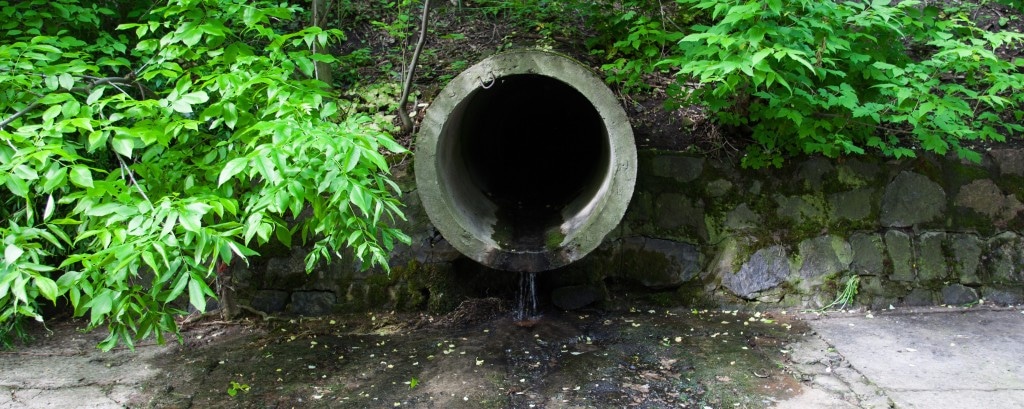
The concrete circular run-off pipe discharging water

On April 13, 2016, EPA issued a news release for the much-anticipated revised General Permit for Small Municipal Separate Storm Sewer Systems (MS4s) in Massachusetts, which was signed into effect April 4, 2016.

What you need to know:

  • Permit becomes effective July 1, 2018
  • A Notice of Intent (NOI) to apply for coverage under the permit will be due September 29, 2018
  • 5-Year permit term
  • Covers 260 municipalities in Massachusetts plus state and federal facilities
  • Permit has the same six minimum control measures as the 2003 MA MS4 permit

The permit allows the following:

  • Permittee may prioritize catch basin inspection and cleaning based on their knowledge of the system
  • Credit for past work
  • Up to ten years to complete illicit discharge requirements
  • One year to update from 2003 Stormwater Management Plan

Other key facts:

  • Permit contains no end-of-pipe limits
  • No retrofits required during the permit term
  • Routine road maintenance and paving are exempt from post-construction requirements

For more information from EPA, please click here.

Informational Public Meetings are being held throughout the state where requirements will be explained and questions can be asked:

Western MA:
Monday May 9, 2016 at 9:30am
Pioneer Valley Planning Commission
60 Congress Street, Springfield

Southeastern MA & Cape Cod:
Wednesday, May 18, 2016 at 12:30pm
Lecture Hall A, Science Building
Cape Cod Community College
2240 Route 132, West Barnstable

Northeastern MA:
Thursday May 19, 2016 at 8:00am
Haverhill Campus
Northern Essex Community College
100 Elliot Street, Haverhill

Central MA:
Tuesday, May 24, 2016 at 8:30am
495/MetroWest Partnership
200 Friberg Parkway, Westborough

Boston Area:
Monday, June 6, 2016 at 9:00am
EPA Region 1
5 Post Office Square, Boston

Tata & Howard has extensive experience assisting municipalities in meeting MS4 permit requirements. Please contact our Stormwater Project Manager Jon Gregory, P.E. directly at 508-219-4016 or jgregory@tataandhoward.com for assistance or if you have additional questions.

MassDEP agrees to co-issuance of new MS4 stormwater permit with EPA

MassDEPDespite serious concerns over costs to municipalities and timing of implementation, MassDEP has agreed to co-issue the new MS4 stormwater permit with EPA. According to a March 31, 2016 letter from MassDEP Commissioner Martin Suuberg to US EPA Region 1 Administrator Curt Spalding, MassDEP agreed to co-issue the permit in spite of concerns in order to remain involved with cities and towns on permit implementation. The letter states, “MassDEP would have preferred some time for additional discussion of important issues. Nevertheless, MassDEP needs to be involved with EPA and cities and towns on how this permit is implemented. This is too important an issue for our environment, for our cities and towns and for the Commonwealth.”

The letter further stated that EPA had not addressed all comments previously submitted by MassDEP, and that the proposed permit would present significant hurdles to municipalities. The complete letter can be read here.

CT DEEP Issues New EAP Requirements for Class C and Class B Dams

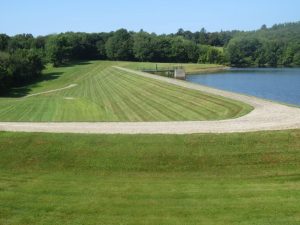
Class C Bronson E. Lockwood Dam, Bethlehem, CT

The State of Connecticut Department of Energy and Environmental Protection (DEEP) recently adopted Regulation 22a-411a concerning the preparation and update of Emergency Action Plans (EAPs) for High Hazard (Class C) and Significant Hazard (Class B) dams.  EAPs meeting the new requirements for Class C dams must be submitted to DEEP within 12 months of February 3, 2016, the effective date of the new regulation, and within 18 months for Class B dams. Dam owners will be required to submit an updated EAP every two years thereafter, or more frequently as necessary to reflect significant changes to the dam structure or downstream area.

An EAP is intended to be a pragmatic document that both identifies conditions that require a response and provides clear instructions in an emergency situation.  “The new requirements for dam owners minimize the potential for dam failures and increase public safety by directing owners to improve oversight and responsibility for their dams through the preparation of Emergency Action Plans (EAPs) and regular inspections,” said DEEP Commissioner Robert Klee.

The new EAP regulations include criteria for inundation mapping, dam monitoring procedures, formal warning notification and communication procedures, and EAP review and revisions. Copies of the EAP must be filed with the DEEP, the chief executive officer, and the emergency management officer of any municipality that would potentially be affected by an emergency involving the dam for which the EAP has been prepared.

For more information, or for assistance meeting the new requirements for Dam EAPs, please contact us.

MWWA Membership Meeting at Leicester Country Club

Karen L. Gracey, P.E., Vice President

JANUARY 28, 2016 — We are at the Massachusetts Water Works Association membership meeting at Leicester Country Club today. In attendance are Karen Gracey, P.E., Vice President and Paul Howard, P.E., Senior Vice President. We’re here to talk water!

EPA Anticipates MS4 Permit to be Released in January 2016

On December 2, EPA and MassDep held a briefing at the State House to update legislators on MS4 permits. EPA stated that they anticipate the permit will be released as early as mid-January 2016.
ms4_permitThe December 2 briefing held at the State House was co-hosted by legislators Carolyn Dykema, State Representative for the Massachusetts 8th Middlesex District and Jamie Eldridge, Massachusetts State Senator representing the Middlesex and Worcester Districts. Jennifer Pederson, Executive Director for Massachusetts Water Works Association, was also in attendance.

The draft permit received over 1,400 comments to which EPA is in the process of responding. Key points include the following:

  • Timing: EPA is looking at spreading out the time frames for compliance. The permit will not be effective on the date it is issued; rather, it will likely be effective six months from the date of issue while also giving permittees 90 days to submit as well as providing more time on the illicit discharge program;
  • Requirements: EPA is working to realign their requirements with state stormwater standards;
  • Training: EPA is working on tools and templates to help with communication and required training, and will be holding several workshops when the permit is released;
  • Cost: EPA is looking for ways to reduce costs to permittees and indicated there would likely be different cost estimates in the final permit compared to the draft permit;
  • Credit for Previous Tasks: EPA intends to give credit for tasks that were completed under the existing MS4 permit so that permittees will not have to repeat tasks.

The legislators in attendance expressed their concern over the costs to their communities to comply, particularly since their towns’ estimated costs for compliance were considerably higher than what EPA originally stated. While EPA said that costs could potentially be adjusted once the permit was released, they also affirmed that costs to communities with TMDLs or impaired waters would be significantly higher in order to sufficiently address water quality issues. However, EPA also stressed that the impending permit is strictly for planning purposes and will not require construction of Best Management Practices.

MassDEP noted that they are currently reviewing all changes that EPA proposes to make to the permit. DEP is particularly interested in seeing if comments that MassDEP Commissioner Marty Suuberg had previously submitted on the draft have been incorporated into the final permit.

Please feel free to contact us with any additional questions on the impending MS4 Permit.

To learn about our stormwater services, please click here.

EPA Provides New England with over $165 Million for Water Infrastructure Projects


606px-Environmental_Protection_Agency_logo.svgThe U.S. Environmental Protection Agency (EPA) has awarded funds to all six New England states to help finance improvements to water projects that are essential to protecting public health and the environment. The funds will be primarily used to upgrade sewage plants and drinking water systems, as well as replacing aging infrastructure, throughout the state. Awards were made to the Clean Water State Revolving Fund (CWSRF) program in each state, which provides low-interest loans for water quality protection projects to make improvements to wastewater treatment systems, control pollution from stormwater runoff, and protect sensitive water bodies and estuaries; and to the Drinking Water State Revolving Fund (DWSRF) program in each state, which provides low-interest loans to finance improvements to drinking water systems, with a particular focus on providing funds to small and disadvantaged communities and to programs that encourage pollution prevention as a tool for ensuring safe drinking water.

The awards are as follows:

  • Connecticut: $26 million — $17.1 million CWSRF, $8.9 million DWSRF
  • Maine: $19.6 million — $10.8 million CWSRF, $8.8 million DWSRF
  • Massachusetts: $63.7 million — $47.4 million CWSRF, $16.3 million DWSRF
  • New Hampshire: $22.7 million — $13.9 million CWSRF, $8.8 million DWSRF
  • Rhode Island: $18.2 million — $9.4 million CWSRF, $8.8 million DWSRF
  • Vermont: $15.6 million — $6.8 million CWSRF, $8.8 million DWSRF

Since the beginning of this program, EPA has awarded approximately $4.554 billion to New England states for the construction, expansion, and upgrading of clean water infrastructure resulting in decreased pollution entering waterbodies throughout the state.

As communities develop and climate patterns shift, water infrastructure needs are expected to grow. Green infrastructure is a cost-effective and resilient approach to water infrastructure needs that provides benefits to communities across the nation.

National Prescription Drug Take-Back Day is September 26

drugs in drinking waterThe United States Drug Enforcement Agency (DEA) is hosting its 10th National Prescription Drug Take-Back Day on September 26th from 10am-2pm local time in every state except Pennsylvania and Delaware, where the event took place on September 12. Sites will be set up throughout communities nationwide so local residents can return their unwanted, unneeded, or expired prescription drugs for safe disposal.

Collection sites in every local community can be found by going to www.dea.gov . This site will be continuously updated with new take-back locations.

While National Prescription Drug Take-Back Day addresses the vital public safety and public health issue of prescription drug abuse, it also addresses the recently recognized problem of prescription medications found in our nation’s water supply. Many Americans do not know how to properly dispose of their unused medicines, often flushing them down the toilet, which causes a significant public health hazard.

In the previous nine Take-Back events nationwide from 2010-2014, 4,823,251 pounds, or 2,411 tons of drugs were collected.