
Health Advisory Guidelines for Per- and polyfluoroalkyl Substances Detected in Public Water Systems
The Massachusetts Department of Environmental Protection (MassDEP) announced in early June, and through the Office of Research and Standards (ORS), its recommendations on the Unregulated Contaminant Monitoring Rule 3 (UCMR 3) for emerging contaminants-specifically Perflourinated Alkyl Substances (PFAS).
PFAS or Per- and polyfluoroalkyl substances are a group of man-made compounds that include perfluorooctane sulfonate (PFOS), perfluorooctanoic acid (PFOA), perffluorohexane sulfonate (PFHxS), perfluorononanoic acid (PFNA), perflouroheptanoic acid (PFHpA), and perfluorobutane sulfonate (PFBS).
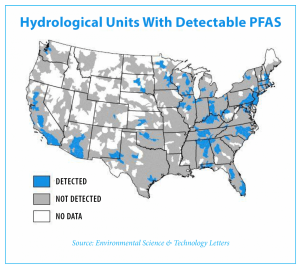 According the Environmental Protection Agency (EPA), all these UCMR 3 PFAS compounds have been detected in public water supplies across the US. Since PFAS are considered emerging contaminants, there are currently no established regulatory limits for levels in drinking water. However, in 2016, the EPA set Health Advisory levels (HA) of 0.07 micrograms per liter (µg/L) or 70 parts per trillion (ppt) for the combined concentrations of two PFAS compounds, PFOS and PFOA.
MassDEP’s ORS established drinking water guidelines that follows the EPA’s recommendations for health advisory levels at 70 ppt, which applies to the sum total of five PFAS chemicals – PFOS, PFOA, PFNA, PFHXS, and PFHpA. And, if the level of contamination poses unacceptable health risks to its customers, Public Water Systems (PWS) must take action to achieve safe levels. They also must provide public notice.
The EPA and MassDEP’s recommended guidelines for PFAS include:
- Public Water Suppliers take immediate action to reduce levels of the five PFAS to be below 70 ppt for all consumers.
- Susceptible health-risk groups (pregnant women, infants, and nursing mothers) should stop consuming water when the level is above 70 ppt.
- Public Water Systems must provide a public Health Advisory notice.
 The EPA also recommends that treatment be implemented for all five PFAS when one or more of these compounds are present.
Although, PFAS are no longer manufactured in the United States, PFAS are still produced internationally and can be imported in to the country1. PFAS have been in use since the 1940’s and are persistent chemicals that don’t breakdown, accumulate over time in the environment and in the human body. Evidence shows that prolonged exposure PFAS can have adverse effects on human health and the ecology.
PFAS can be found in:
- Agricultural products grown in PFAS-contaminated soil or water, and/or handled with PFAS-containing equipment and materials.
- Drinking water contaminated from chemical groundwater pollution from stormwater runoff near landfills, wastewater treatment plants, and firefighter training facilities2.
- Household products, including nonstick products (e.g., Teflon), polishes, waxes, paints, cleaning products, and stain and water-repellent fabrics.
- Firefighting foams2, which is a major source of groundwater contamination at airports and military bases where firefighting training occurs.
- Industrial facilities that manufactured chrome plating, electronics, and oil recovery that use PFAS.
- Environmental contamination where PFAS have built-up and persisted over time – including in fish, animals and humans.
While most states are relying on the EPA’s Health Advisory levels (including Massachusetts), some, such as Connecticut, Minnesota, New Jersey, Arizona, and Colorado have addressed other UCMR 3 PFAS pollutants as well.
 Most research on the effects of PFAS on human health is based on animal studies. And, although there is no conclusive evidence that PFAS cause cancer, animal studies have shown there are possible links. However, PFAS ill-health effects are associated with changes in thyroid, kidney and liver function, as well as affects to the immune system. These chemicals have also caused fetal development effects during pregnancy and low birth weights.
PFAS are found at low levels throughout our environment—in foods we consume and in household products we use daily. PFAS in drinking water at levels higher than the EPA’s recommendations does not necessarily mean health risks are likely. Routine showering and bathing are not considered significant sources of exposure. And, while it is nearly impossible to eliminate all exposure to these chemicals, the risk for adverse health effects would likely be of concern if an individual continuously consumed higher levels of PFAS than the guidelines established by the EPA’s Health Advisory.
MassDEP is continuing its research and testing for PFAS in Public Water Systems. Large Public Drinking Water Systems have already been tested and sampling indicated that approximately 3% had levels of PFAS detected. MassDEP is currently working with smaller Public Water Systems to identify areas where PFAS may have been used or discharged to the environment.
As more information and regulations develop on this emerging contaminant, MassDEP will continue to communicate their findings. Tata & Howard is also available for any questions that may arise, as well as, assist with testing and recommend treatment options for our clients.
1 In 2006, the EPA and the PFA industry formed the PFOA Stewardship program to end the production of PFAs.
2 MassDEP in partnership with the Massachusetts Department of Fire Services (MassDFS), announced in May a take-back program to remove hazardous pre-2003 firefighting foam stockpiles and be neutralized. Manufacturers stopped making PFAS foam in 2002 and have since developed fluorine-free and more fluorine stable foams that are safer to the environment.
 Water systems today face a set of problems that are unique to this generation. While our nation’s buried infrastructure is crumbling beneath our feet as it reaches the end of its useful life, supplies are dwindling, budgets are shrinking, and federal and state funding is drying up. At the same time, regulatory requirements continue to increase as emerging contaminants are identified. Water systems often find themselves in the quandary of whether to upgrade treatment systems to comply with these new regulations or update assets that are long overdue for replacement or rehabilitation.
 In addition to addressing capital efficiency, water utilities of today must also address operational efficiency. Because water systems are required to do so much with so little, efficiency in all aspects of water system management is critical. Tata & Howard appreciates the unique set of challenges faced by water systems today, and we have experts on staff who understand the inner workings of a water utility – and how to improve them.
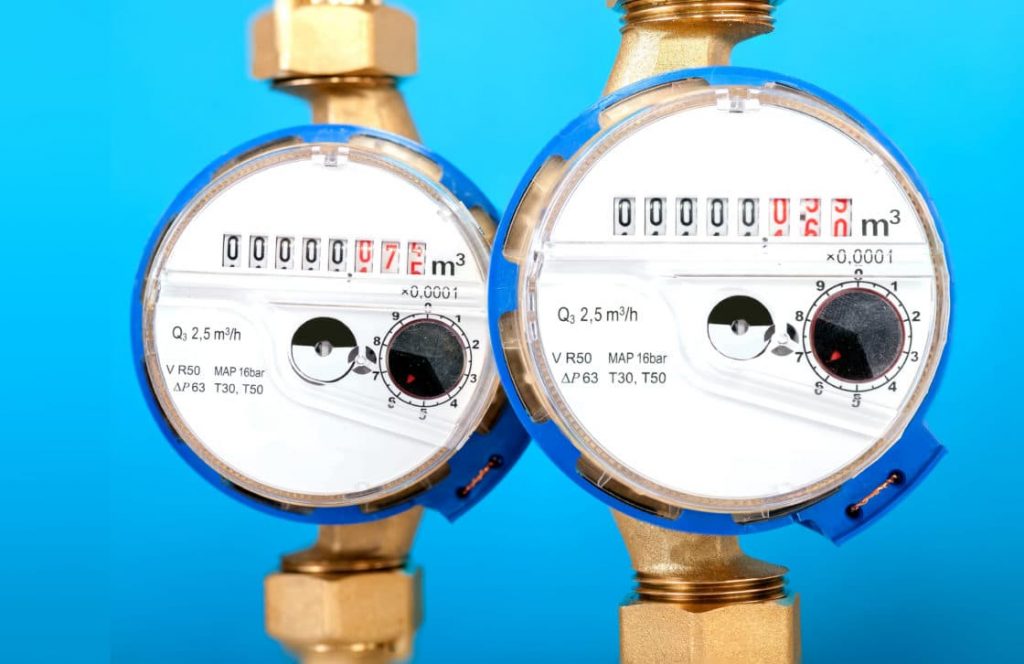 Besides improving operational and capital efficiency, water systems of today must reduce non-revenue water. Non-revenue water is treated drinking water that has been pumped but is lost before it ever reaches the customer, either through real losses such as leaks, or through apparent losses such as theft or metering issues. In the United States, water utilities lose about 20% of their supply to non-revenue water. Non-revenue water not only affects the financial health of water systems, but also contributes to our nation’s decreasing water supply. In fact, the amount of water “lost” over the course of a year is enough to supply the entire State of California for that same year. Therefore, the AWWA recommends that every water system conduct an annual water audit using M36: Water Audits and Loss Control methodology to accurately account for real and apparent losses.