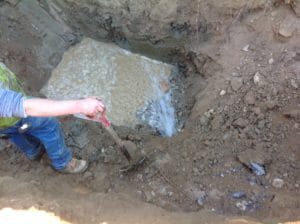
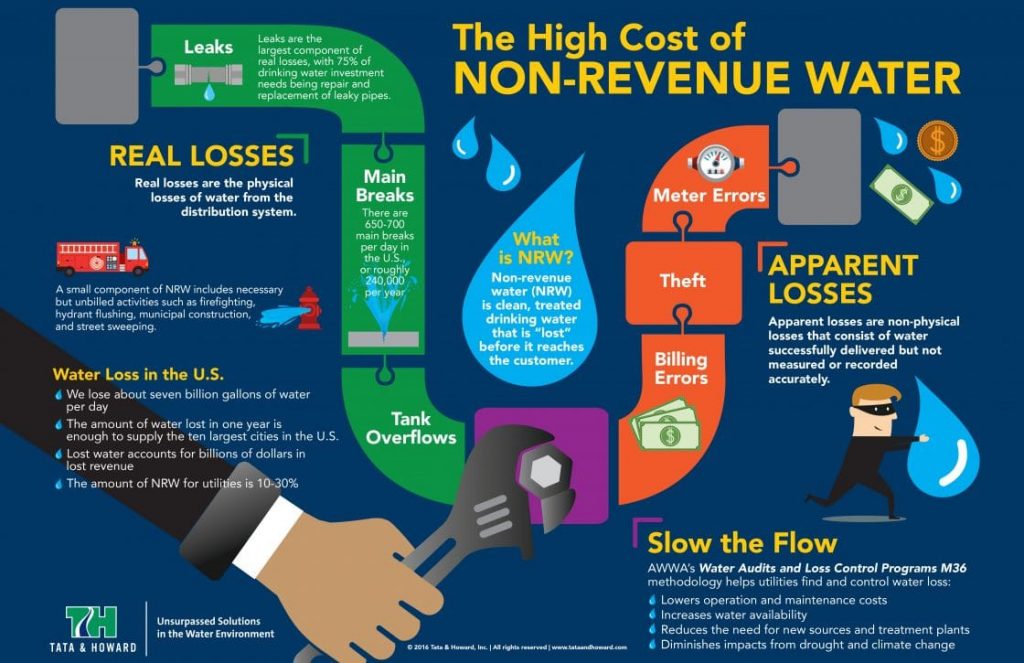
Every day, United States utilities lose around seven billion gallons of clean, treated drinking water. This “lost” water, referred to as non-revenue water (NRW), is caused by a number of factors, including leaking pipes, water main breaks, theft, and improper accounting of water. In fact, we lose enough water each year to supply our ten largest cities. Of the estimated $200 billion needed over the next 20 years to upgrade our water distribution systems, $97 billion is needed for water loss control. With water crises occurring throughout the country, NRW is a big deal.
How NRW Affects You
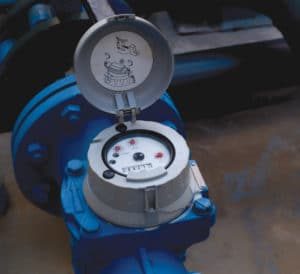
Non-revenue water affects everyone in a water distribution system. Although it is considered “non-revenue” water, many utilities include these costs in their rates, which is reflected in your bill. The less NRW a water utility produces, the lower its total costs will be. And let’s face it: no one wants to pay for things they don’t use. Also, a lower percentage of NRW reflects positively on your local water utility’s performance. Utilities with low NRW percentages typically perform well at replacing broken water mains and meters, and defending against theft.
When water leaks from pipes, it can erode the subsurface underneath roads and other public
infrastructure. When the erosion reaches a critical point, the road collapses or a building’s foundation can fail. The better your water utility performs in NRW reduction, the less likely your community will need to replace its public infrastructure, especially roads. Our population is continuously growing and without improved efficiency, water supply expansion and treatment projects will be necessary — significantly increasing the cost of water. Improving water use efficiency by reducing NRW defers the expense of water supply expansion and treatment. If we can prevent clean, treated water from getting “lost,” there will be less of a need to find new sources or increase capacity.
Leaking pipes contributing to non-revenue water also can pose a health risk to communities. Contaminated groundwater from leaking sewage or pollution can find its way into drinking water pipes during low pressure events. Contaminated drinking water then has the potential to spread disease and other harmful substances.
Water Audits and NRW
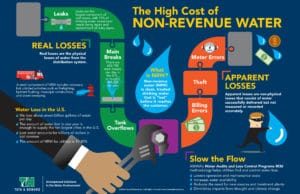
The best way to reduce a utility’s NRW is through routine water audits. Most utilities in the U.S. conduct infrequent water audits and, therefore, are likely suffering substantial losses without even being aware of it. Since 2005, a number of state and regional water resource agencies in the United States have established water audit reporting requirements for water utilities. In addition, the American Water Works Association (AWWA) has developed and published a methodology for identifying and controlling NRW, M36 Water Audits and Loss Control Programs, now in its fourth edition. Tata & Howard Vice President Steve Rupar, P.E. co-authored chapters 4 and 5 of the new M36 manual, which focus on the causes of apparent loss and what can be done to control it. An expert in water loss control, Steve has also given presentations and a webinar on the subject, which can be found here. Water audits help utilities identify the causes and costs associated with water loss, and develop strategies to avoid NRW. They also help to identify areas of a distribution system requiring repairs or maintenance. Water audits are important, especially in the northeast, where some infrastructure is over 100 years old. Preventing NRW helps save our infrastructure, our money, and most importantly, our water.
In Conclusion
NRW affects everyone, and it’s important to monitor and continuously improve water  distribution systems. Water audits are a vital step toward reducing lost water while improving water infrastructure. We lose billions of dollars every year to NRW — money that could be used to improve our infrastructure or to support other clean water initiatives. Water lost is water and money wasted, and the less NRW a utility has, the better off it — and its customers — will be.
 Fix a Leak Week is celebrated in the United States each March in order to remind people to check their homes for leaks, both indoors and out. Household leaks account for more than one trillion gallons of wasted water annually in the United States. To put it into perspective, that’s equal to the annual household water use of over 11 million homes. Fix a Leak Week encourages homeowners to repair their dripping faucets, leaky toilets, old showerheads, and faulty irrigation systems in an effort to save our nation’s water. But that’s only part of the problem.