Blueprint for the Future: How Capital Efficiency Planning Is Revolutionizing Water & Wastewater Management

Water and wastewater utilities are finding themselves faced with unprecedented conditions. Aging infrastructure, evolving regulations, climate pressures, and limited funding are no longer just isolated issues, but instead are interconnected barriers that threaten a system’s reliability and resiliency.

In this time of increased challenges, utilities need more than just reactive fixes or short-term capital improvement plans. They need a smarter, more strategic approach. This is where Capital Efficiency Planning is transforming the industry.

capital-efficiency-planning

Breaking the Cycle: Aging Infrastructure and Reactive Spending

The biggest barrier when it comes to building resilient water and wastewater systems is the cycle of reactive spending, fueled by two persistent challenges: rapidly aging infrastructure and limited funding.

Much of the nation’s water infrastructure was built in the mid-20th century and is now well beyond its intended lifespan. As a result, delayed maintenance, emergency repairs, and piecemeal upgrades have become the norm rather than the exception. The outcome? A cycle of inefficiency with unexpected failures leading to expensive emergency fixes and further strain on already limited budgets.

At the same time, funding uncertainty and political pressures around rate increases make it incredibly difficult to plan, let alone with confidence. Capital dollars are constantly competing with operational demands, and without a clear, data-driven strategy, utilities become trapped in a reactive cycle rather than improvement. This pattern doesn’t just strain finances, but also jeopardizes the reliability of the system and public trust. The real challenge is not just fixing problems as they arise, but preventing them in a way that is both financially sustainable and operationally resilient.

From Reactive to Proactive: the Capital Efficiency Plan (CEP) Advantage


One of the most critical aspects of CEPs is their ability to transform utility efforts from reactive to proactive.

Traditional capital improvement plans (CIPs) focus on near-term needs, often spanning between five to ten years and prioritizing projects based on immediate concerns. While CIPs are incredibly useful, they can often fall short when it comes to building long-term resilience and financial sustainability.

CEPs take a broader and more integrated approach. Rather than simply identifying projects, at Tata & Howard our CEP methodology mimics a Venn diagram with three sets of evaluation criteria:

  • Hydraulic Modeling: helps utilities understand how their systems perform under current and future demands, identifies deficiencies, and validates model data
  • Critical Component Assessment: evaluates assets that serve essential functions and whose failure would significantly impact performance
  • Asset Management Scoring: assigns risk scores based on their current conditions to determine if repair or replacement is required

By combining these elements, our methodology allows utilities to prioritize their efforts and investments based on risk, asset condition, and long-term value. Instead of chasing failures, utilities can anticipate and prevent them.

Doing More with Limited Budgets

Budget constraints remain one of the most significant pain points for utilities. Even when the need for investment is clear, funding is often insufficient or uncertain. This makes it increasingly difficult for utilities to address aging infrastructure while also preparing for future challenges.

CEPs help utilities make the most out of every dollar. By evaluating the full lifecycle cost of assets and identifying the most cost-effective interventions — whether rehabilitation, replacement, or operational improvements — CEPs ensure that capital is allocated where it will have the greatest impact.

This more disciplined approach allows utilities to stretch their limited budgets even further while still improving their system’s performance and reliability. With limited budgets, that efficiency is essential to building resilience.

Where Resilience Meets Financial Strategy

Resiliency is not just an engineering challenge, but also a financial one. A system cannot be considered resilient if its capital plan is not financially sustainable.

CEPs integrate financial planning directly into the capital decision-making process. They evaluate funding scenarios, rate impacts, and financing strategies alongside infrastructure needs, creating a blueprint for balancing technical priorities with fiscal responsibility.

This integration is critical. It allows utilities to plan for the future with confidence, ensuring that necessary investments are both achievable and sustainable. It also helps avoid the risk of overextension, where ambitious plans can fall short due to lack of funding.

Building Systems That Can Adapt and Endure

For a system to be resilient, it must not only be robust, but also adaptable. As climate patterns shift, regulations evolve, and communities grow, it’s critical for water and wastewater infrastructure to be able to respond to changing conditions.

CEPs support this adaptability by taking a long-term, flexible approach to planning. CEPs consider future scenarios, incorporate new data over time, and allow utilities to adjust their strategies as these conditions change.

This forward-thinking perspective ensures that the investments made today will continue to deliver value in the future.

A Blueprint for Resilience

CEPs effectively break reactive cycles by putting resiliency at the forefront of decision-making and are fundamental to long-term performance and efficiency. By prioritizing investments based on risk, asset condition, and long-term value, CEPs enable utilities to shift from emergency response to proactive system management. They reduce lifecycle costs, optimize capital spending, and create a more predictable and data-driven investment strategy.

Most importantly, they allow utilities to move beyond short-term fixes and toward a sustainable approach that strengthens infrastructure, protects budgets, and ensures reliable service for the future.

Project Manager, Water Engineering – Shelton, CT

Job Description

We are looking for a qualified and highly motivated Project Manager, Water Engineering with 10-12 years’ experience in water distribution engineering to join our Shelton, CT office. The selected candidate will work directly with our clients and a team of design engineers in a variety of civil engineering projects including pipelines and pump stations. The successful candidate will have a proven record of meeting project deadlines and budgets.  Other responsibilities include mentoring and training junior engineers, coordinating / participating in the preparation of plans and specifications, technical report writing, and documenting project activities, findings, and recommendations, with limited supervision. This position will also have business development responsibilities including lead identification, prospect meetings, and participation in proposals as appropriate.  The candidate must be a self-starter with a solid understanding of the consulting engineering industry. Familiarity with Deltek Vision project management system a plus.

Requirements:

  • Bachelor’s degree in Civil or Environmental Engineering.
  • 10-12 years of experience in the consulting engineering industry involving the design of municipal water systems.
  • Registered Professional Civil Engineer in the State of Connecticut or the ability to obtain through reciprocity.
  • Previous experience working on and managing projects for municipal water clients.
  • Proven history of developing and managing projects from design through construction.
  • Candidate must have strong technical skills.
  • Strong written and verbal communication, organizational and interpersonal skills.
  • Candidate must be able to work well independently and in teams and manage multiple projects simultaneously.

Project Engineer, Water Engineering – Marlborough, MA

Job Description:

We are looking for a qualified and highly motivated Project Engineer, Water Engineering with 4-7 years’ experience in water distribution engineering to join our Marlborough office. The selected candidate will work directly with our clients and a team of design engineers in a variety of civil engineering projects including pipelines, pump stations, and water treatment. The successful candidate will have a proven record of meeting project deadlines and budgets. Other responsibilities include mentoring and training junior engineers, coordinating / participating in the preparation of plans and specifications, technical report writing, and documenting project activities, findings, and recommendations, with limited supervision. The candidate must be a self-starter with a solid understanding of the consulting engineering industry. Familiarity with Deltek Vantagepoint project management system a plus.

Requirements:

  • Bachelor’s degree in Civil or Environmental Engineering.
  • 4-7 years of experience in the consulting engineering industry involving the design of municipal water systems.
  • Registered Professional Civil Engineer in the State of Massachusetts or the ability to obtain through reciprocity.
  • Previous experience working on and managing projects for municipal water clients.
  • Proven history of developing and managing projects from design through construction.
  • Candidate must have strong technical skills.
  • Strong written and verbal communication, organizational and interpersonal skills.
  • Candidate must be able to work well independently and in teams and manage multiple projects simultaneously.

Please note that Tata & Howard does not sponsor applicants for work visas.

Employee Spotlight: David Lombardo

Employee Spotlight #7 – It is our pleasure to shine the spotlight on David J. Lombardo, P.E., Associate.

David’s career in engineering began in 1994. Directly out of college, he started a job with Roald Haestad, Inc., learning the water and wastewater aspects of civil engineering with a specific emphasis on Pump Station designs and construction oversight. In 2014, Tata & Howard acquired Roald Haestad, Inc., and David joined the Tata & Howard team.

His experience with Pump Station designs has been extensive, ranging from small to very large and complex. David summed up his experience by saying, “the unique challenges of the modern-day pump station design always comes down to the fact that no two pump station designs are identical; each has its own parameters and challenges.”

He shared that project considerations are many when designing a pump station beyond the water demands and pump capacities; other factors such as space availability, safe access, durability, low maintenance, upgradeability, etc., while balancing the client needs and staying on budget.

David shared that one pump station design project was particularly challenging due to limited land availability; Eventually, a house foreclosure in the area allowed the project to move forward. The design maintained the outer façade of the house with interior modifications that included gutting the inside and casting concrete floors to convert the interior into a potable water pumping station complete with four pumps, associated piping, electrical equipment, instrumentation, and controls.

The design included converting an attached garage into a standby power generator room equipped with acoustic louvers in the walls for cooling and combustion and lined with sound deadening insulation to minimize generator noise from reaching the neighbors. This above-ground replacement pump station allows easy access and enhanced safety while blending in with the neighborhood aesthetics.

David’s passion and experience for pump station designs continue to expand, building upon what he shared at the beginning of this spotlight, “the unique challenges of the modern-day pump station design always comes down to the fact that no two pump station designs are identical.” Thanks for sharing David!

Let’s Connect:
David J. Lombardo, P.E., Associate
37 Brookside Road, Waterbury, CT 06708

E – dlomardo@tataandhoward.com     |     P – 203-528-0263  


Employee Spotlight: Paul Howard

Employee Spotlight #6: We are excited to shine this week’s employee spotlight on Senior Vice President, Paul Howard. Paul co-founded Tata & Howard nearly 30 years ago with the late Donald J. Tata, and has been dedicated to the company since day one, October 19, 1992.

Coming from a long line of engineers, Paul’s father, grandfather, and great-grandfather owned Whitman & Howard, Inc., a prominent New England civil engineering firm founded in 1867. Growing up around engineers provided Paul the opportunity to be exposed to the field at a young age, and as early as 5-years-old, he could be found on construction sites with his father. By 14 he was working on a survey crew gaining even more experience before entering Worcester Polytechnic Institute to obtain a degree in civil engineering.

Paul’s favorite types of projects involve water treatment plants and water supply development. The most memorable project worked on, and the second official T&H project, was the Elm Bank Pump Station job, no. 1002. The Elm Bank Pump Station was the culmination of approximately 10 years of work to develop the water supply for the Towns of Natick, Wellesley, Needham, and Dover. Natick was the only Town to move forward with developing the source. At the time, the pump test for the supply was the largest pump test ever conducted in the state of Massachusetts. Four wells were pumped at 4 million gallons per day.  Seven thousand feet of discharge piping was used. The permitting for the project was extensive and in the end limited the Town to 2.2 mgd out of an approval yield of 7.0 mgd.

When he’s not at one of the T&H offices, Paul enjoys golfing and snowboarding, traveling, and spending time with family. A fond travel memory dates back to childhood when he went fishing at the Arctic Circle and the Northwest Territory of Canada. On this special trip he caught a 31.5 pound lake trout, an 11 pound arctic char, saw an albino wolverine, and piloted a six passenger airplane.

Employee Spotlight: Karen Gracey

Employee Spotlight #5: Karen Gracey. Over the last 25 years, she has held each role at the company, starting first as a summer intern, and working her way up to Co-President.

With a degree in Civil Engineering from the University of Vermont, Karen is passionate about environmental engineering and fixing problems to make a positive impact with each project she is a part of. She enjoys hydraulic modeling and system analysis as each project offers an opportunity to figure out why certain issues are happening with a water system.

Karen’s favorite project at T&H to date was the company’s first Capital Efficiency Plan completed for the Connecticut Water Company for the Unionville System. Conducting research, collaborating on the various sections of the report, and then writing it from scratch was a fun and fulfilling task.

When she isn’t at T&H, Karen enjoys cooking, skiing, and relaxing at the beach. A trip to Napa Valley with her brother and sister a few years ago is one of her favorite travel memories. Driving in a limo to small vineyards in Sonoma Valley and Russian River provided lots of delicious wine, beautiful landscapes, and spending time with family.

Fun Fact: During the summer of her internship at T&H, Karen dove headfirst into hydraulic modeling and water main design. In addition, she also learned a lot about blueline machines. For those who are not familiar, blueline machines use black lights and ammonia to copy a drawing printed on vellum onto special paper. Copying one drawing would take a minute or two, so imagine making multiple copies of water treatment plant drawings! 

Thanks for all you do, Karen!

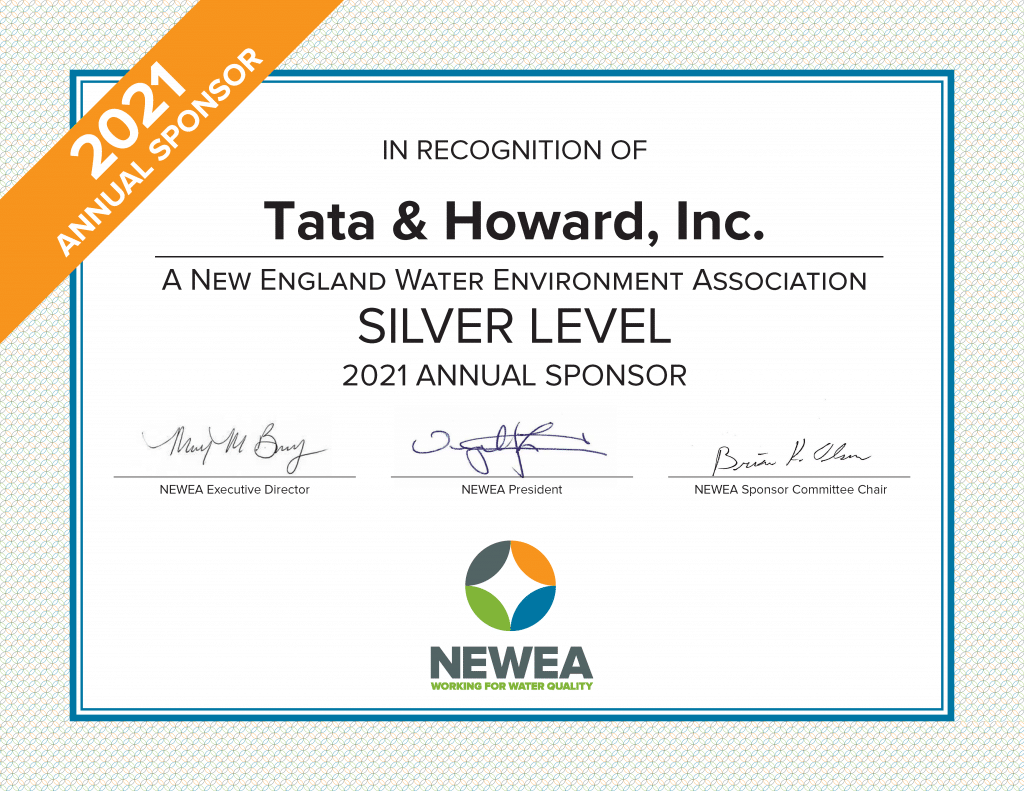
NEWEA 2021 Silver Sponsor

Tata & Howard was pleased to participate in the 2021 NEWEA Sponsorship Program and is grateful to be a supporter of NEWEA each year.

Employee Spotlight: Robert Sims

Employee Spotlight #4: We are delighted to shine our employee spotlight on Robert Sims. Southerner by birth, Robert was born in Kentucky and raised in Austin, TX before relocating to Massachusetts 35 years ago. Having a long line of engineers/surveyors in his family, including an ancestor who performed the survey of record for the Common in Cambridge, MA in the 17th century, he knew from a young age that he wanted a career in the field.

He attended the University of Texas at Austin with initial sights on Electrical Engineering, but quickly changed to Civil Engineering after hearing a presentation from the Dean of the UT Cockrell School of Engineering.

With more than thirty years of design and construction project management experience under his belt, Robert joined Tata & Howard in 2018 as a PM. He has most enjoyed working on two water quality studies for the towns of South Deerfield and Mattapoisett, as he was able to form a great working relationship with his team and clients, and produced solid reports with PF’s above 3.

Around the office, Robert is known for his friendly personality, fascinating hobbies, and amusing stories. He enjoys woodworking, beekeeping, fantasy football, and gardening. To stay active, he participates in stair climb races for the American Lung Association, the Scottish Highland Games, and the occasional 5k race.

Robert is passionate about his Scottish heritage and can often be seen wearing his kilt. In fact, he sat in the X-wing fighter from Star Wars…while wearing a kilt, and flew in a WWII vintage P-51 fighter…while wearing a kilt.

Thanks for all you do, Robert!

NEWWA Spring Learnapalooza 2021

Tata & Howard is pleased to participate in New England Water Works Association’s (NEWWA) 2021 Spring Learnapalooza from March 29-April 1.

T&H will be sponsoring Technical Session 6, ‘Emergency Preparedness’, on Tuesday, March 30, with a brief presentation on Emergency Response and Continuity of Operations Plans.

If you missed the technical session sponsor video, don’t worry, you can watch below!


ATCAVE 2021

Tata & Howard is pleased to be a sponsor of Connecticut’s premier water supply event, the Connecticut Section AWWA Annual Technical Conference and Vendor Exposition (ATCAVE). ATCAVE celebrates 25 years on Tuesday, February 23-Thursday, February 25, 2021!