Imagine a day without water. Nearly every single thing we do is reliant on water. Right at the start of our day, we would not be able to use the bathroom, take a shower, brush our teeth, or make a cup of coffee. There would be no cleaning dishes, mopping floors, or cooking food. Water is something we use constantly throughout the day without even thinking about it, and has therefore become something we take for granted. For that reason, Imagine a Day Without Water was first introduced in 2015 in order to bring awareness to the value of water.
Think about how frustrating it is when our internet or cell phone service is interrupted. Having no signal or losing WiFi on our laptops can grind work to a halt, as well as bring about headaches and aggravation — but it doesn’t actually affect our health or our lives. And yet, in America we pay approximately $50 per month for internet, $75 per month for our cell phone bill, and a whopping $100 for the luxury of cable television. Ironically, the average monthly water bill is only about $30, and people often bemoan the fact that the cost of water has been increasing in recent years. The reality is that providing safe, clean drinking water and treating our wastewater is extremely complicated – and costly.
Think about the way water enters our homes and businesses, and of how our wastewater leaves it. There are literally thousands of pipes underground that we never see, and many of these pipes are approaching the end of their useful life. After all, most of our infrastructure was built around the time of World War II, and is now over 70 years old. In fact, much of the infrastructure in New England is well over 100 years old. These pipes and treatment plants are in desperate need of repair and replacement. In addition, our drinking water is treated to meet increasingly stringent regulations that protect our health. Bacteria, toxins, metals, and other harmful substances are all removed from the water prior to it entering the distribution system, and this treatment is expensive. In the same way, the wastewater that leaves our homes and businesses is highly treated and cleaned before it is returned to the environment, protecting public health from the myriad toxins and diseases found in untreated wastewater.
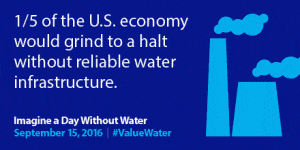
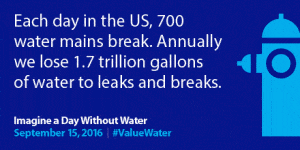
Failing pipes from our aging infrastructure also account for an astronomical amount of clean, treated drinking water that never reaches the consumer, and is never billed. This “lost” water comes at a staggering cost. To put it into perspective, the cost of this lost water is approximately $2.6 billion annually — which is approximately equivalent to the annual amount that the federal government allots to fund our water infrastructure — and the 1.7 trillion gallons of lost water is about the same amount of water needed to fully supply America’s ten largest cities.
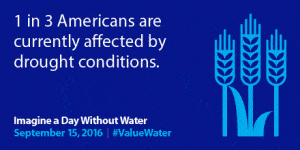
Another challenge faced by utilities today is our growing national population combined with historic drought and climate change. This increased demand in the wake of a dwindling supply is placing extra pressure on our water and wastewater systems, and requires thoughtful, long-term solutions if we are going to be able to meet current and future demands. Add to that the recent focus on our nation’s lead service lines and the fact that they absolutely need to be replaced, and it becomes clear that our water and wastewater systems are in desperate need of attention — and investment.
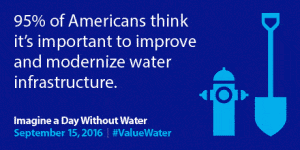
Imagine a Day Without Water is a national movement that is looking to change the way we look at water, which is currently highly undervalued. It is by far the least expensive of all of our utilities, and yet it is the only one without which we cannot live. Consider that the cost to repair our nation’s water and wastewater infrastructure will require an estimated investment of $4.8 trillion over the next 20 years, and it becomes apparent that the time to invest is now. The key to funding our nation’s water and wastewater systems is education and placing the proper value on water. It is crucial that legislators and ratepayers support utilities in their efforts to upgrade and replace infrastructure, to address the funding gap for these critical projects, and to acknowledge and address the water supply challenges that we currently are facing.
We have reached the point where we must proactively address and invest in our nation’s water and wastewater infrastructure — before it is too late. Imagine a Day Without Water is a day in which we can all spread the word about the value of water by encouraging friends, family, and colleagues to imagine what their lives would be like without water. With proper planning and smart investment from both consumers and our legislators, living without water is something that will never come to fruition in our nation. Join the movement today by participating in Imagine a Day Without Water. For the many no-cost ways in which you can participate, including signing a petition, joining a Thunderclap, and becoming involved on social media, please visit https://imagineadaywithoutwater.org/participate.
Milford Water Company water main installation; design, construction administration, and resident observation by Tata & Howard
By now, everyone has heard of the water crisis that occurred in Flint, Michigan when the City switched the source of its municipal water from the Detroit system to the Flint River in an effort to cut costs. Anti-corrosion chemicals were not added to the water, allowing lead to leach from the City’s aging pipes into the water supply. In the aftermath, hundreds of children suffered lead poisoning, officials were fired, arrests were made, and lawsuits were filed. And while the Flint disaster was arguably terrible and tragic, it has brought much-needed attention to the state of our nation’s infrastructure, and the criticality of maintaining and improving it.
Lead Service Lines in the United States
There are an estimated six million lead pipes remaining in use in the United States, utilized by over 11,000 water systems that serve nearly 22 million Americans, yet there is no federal plan in place to replace these lead service lines. Why? First, it would cost an exorbitant amount of money — roughly $30 billion — to replace every single remaining lead service line, money that utilities simply do not have. With failing infrastructure, dwindling budgets, more stringent regulatory requirements, and increased demand, utilities are doing everything they can simply to maintain service and compliance. To mitigate lead in drinking water, utilities that are unable to dig up all their lead service lines are instead treating water so that it forms a coating on the interior of the pipes. This coating serves as a protective barrier between the water and the lead pipes, preventing lead from leaching into the water supply. This methodology requires extreme vigilance, as water chemistry often changes, which can cause corrosion controls to fail. Fortunately, utilities regularly test their water for lead contamination, and on February 29, 2016, the EPA changed testing regulations to more accurately reflect the amount of lead in drinking water.
Lead in the Drinking Water of Public Schools
While utilities are working diligently to keep our nation’s water lead-free, public schools have recently come under fire, as schools from cities across the nation — including Boston, Massachusetts; Ithaca, New York; Portland, Oregon; and Tacoma, Washington — have found lead in their drinking water above the EPA’s action level of 15 parts per billion. Surprisingly, this contamination is the result of a legal loophole that many states are looking to close: schools are mandated by the EPA to be connected to a water supply that is regularly tested for lead and other contaminants; however, these utilities are not typically required to actually test the water inside the schools themselves. Considering that the average age of a school in the United States is 44 years old, it should come as no surprise that there are elevated levels of lead in the drinking water of public schools. After all, lead pipes were legal until about 30 years ago, and faucets and fixtures were allowed to contain up to 8% lead until 2014.
Lead poisoning is particularly detrimental to school-aged children, and public outcry — largely as a result of Flint’s crisis — has spurred many schools to voluntarily test their water. The findings have been shocking to parents and educators, as school across the nation, from Maine to Washington state, are reporting lead levels above the EPA’s action level. Every day, another news story crops up with a report on elevated lead in a county’s school system, and it becomes apparent that our nation has a serious problem on its hands. Just as with water utilities, the ideal solution would be to replace all the lead pipes and fixtures in our nation’s schools, but again, funding for large-scale replacement just isn’t available. Instead, many schools have turned to lead filters, which work extremely well when maintained regularly.
Looking Ahead
Many states have introduced legislation this year that would require public schools to regularly test their water. Bills on the table in Michigan, New Jersey, North Carolina, and Rhode Island would require regular testing, as would a New York bill that takes it one step further by providing funding for said testing. In addition, the New York bill would require schools to notify parents and to provide an alternate supply of safe drinking water to students if elevated lead levels are found. In Massachusetts, all community water systems are required by Massachusetts drinking water regulations to collect lead and copper samples from at least two schools or early education and care program facilities that they serve in each sampling period, when they collect their Lead and Copper Rule (LCR) samples. In addition, in April of 2016, it was announced that $2 million from the Massachusetts Clean Water Trust (MCWT) will fund cooperative efforts to help Massachusetts public schools test for lead and copper in drinking water. The funds, to be used by the Massachusetts Department of Environmental Protection (MassDEP), will provide technical assistance to ensure that public school districts can sample the taps and water fountains in their schools, and to identify any results that show lead and copper contamination over the action level. On a federal level, legislation has been introduced to Congress that would requires states to assist schools with testing for lead; however, it does not provide funding.
In Conclusion
As long as lead service lines and plumbing remain in use in our nation, there remains a risk of lead contamination of our drinking water. Utilities, states, and schools are doing what they can to limit this risk as much as possible, but the only fail safe solution is full replacement of all lead service lines and fixtures — a massive undertaking that will require significant capital investment that is not currently available. Therefore, it is imperative that utilities and schools continue to remain vigilant about testing for and mitigating lead in drinking water, even after the public outcry from Flint has faded.
World Water Week in Stockholm is an annual event that focuses on global water issues. One of the key aspects of World Water Week is the coming together of industry experts in an effort to brainstorm and develop solutions to the world’s most pressing water-related issues.
World Water Week is organized by the Stockholm International Water Institute (SIWI), whose vision is a water wise world where the unique value of water is recognized and where water is shared and allocated sustainably, equitably, and efficiently to meet everyone’s basic needs. This year’s theme is Water for Sustainable Growth, and also marks the 20th jubilee of the Stockholm Junior Water Prize. In 2015, over 3,300 individuals and close to 300 organizations from 130 countries participated in World Water Week.
Importance of Water for Sustainable Growth
As the global population continues to increase exponentially, it has become absolutely critical that natural resources be utilized sustainably — and water is arguably the world’s most precious resource. While water is a necessary part of every aspect of life, water availability will be of particular import in five key areas, expanded below.
Agriculture
Agriculture is not only critical to nourishing the global population, it is also far and away the most aggressive consumer of water. In fact, 70% of water withdrawals worldwide are for agriculture. Add to this the fact that by 2050 global agriculture will need to produce 60% more food in order to feed the burgeoning population, and it becomes clear that finding ways to farm sustainably is not only prudent, but necessary. The most sustainable form of agriculture comes in the form of rain fed crops. However, only about half of agriculture that has the potential to be rain fed is currently doing so. The rest is relying on irrigation and water withdrawals. Therefore, a key goal for the future is to convert these irrigated crops into ones that are watered naturally, with rainfall.
Industry
The second largest consumers of water are industry and energy, which combined account for 20% of the global water demand. Most of this demand is, of course, from developed countries, since underdeveloped countries typically are dominated by agriculture. Therefore, there exists a serious imbalance in industrial water usage and concern over the future as industrialization spreads as these underdeveloped nations expand. Therefore, water experts are working together to find ways in which all nations can benefit from industrialization while avoiding unsustainable impacts on water demand as well as other natural resources.
Domestic
Domestic usage only accounts for 10% of total water demand, but its impacts are arguably the most important. Lack of improved water and sanitation is one of the largest contributors to poverty, illness, and lack of education worldwide. Even with the incredible strides made in the United Nation’s goal to provide improved water and sanitation to all people, an estimated 748 million people still lack access to an improved source of water and 2.5 billion still lack access to improved sanitation. One of the key goals of water for sustainable growth is finding ways in which to unequivocally ensure safe, clean water and hygienic, private sanitation to all inhabitants on the planet.
Ecosystems
Adding to the challenge of water for sustainable growth for agriculture, industry, and domestic usage is the fact that climate change and an ever-increasing population have created a significant impact on our environment. Sustainable development has been a buzzword for decades, and yet most efforts have been largely unsuccessful. Rainforests have been stripped, aquifers practically drained, air quality degraded, and soils contaminated. No longer can sustainable development be a catch phrase or theory – the time has come for a proactive, targeted response to the global ecological crisis, including water supply and demand. Fortunately, savvy water and ecological experts from around the globe are currently working hard towards a sustainable future for generations to come.
Cities
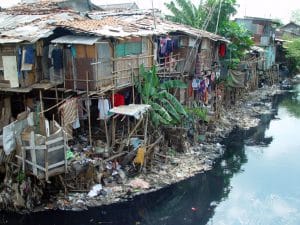
Currently, over half of the global population resides in cities, and that number is expected to increase to over two-thirds of the nine billion global inhabitants by 2050. Most of this increase will happen in developed nations, which will tax infrastructure and likely increase areas of impoverished living conditions. Already in the United States are areas, such as Navajo Nation and the Texas Colonias, that are in many ways similar to those in underdeveloped nations in terms of infrastructure and resource availability. And, with the influx of urban residents, those areas of substandard living conditions are likely to increase – and not just in America. In fact, it is predicted that, without proactive planning, global urban populations will almost certainly experience a serious degradation in living conditions, including inadequate water and sanitation facilities. Therefore, the sustainable development of water resources for not only economic and industrial growth, but also for social equality and justice will be key to the sustainable development of urban areas.
In Conclusion
Sustainable development of water resources is paramount for the future health and success of our planet. SIWI’s World Water Week is a way in which experts from around the world are able to meet, discuss, share ideas, and thoughtfully plan for a sustainable future. For more information on World Water Week, including updates, activities, and how you can participate, please visit www.worldwaterweek.org.
Lake Francis Case, named after former South Dakota Senator Francis Higbee Case, has a total capacity of 3,800,000 acre-feet, stretches over 100 miles, has a shoreline of 540 miles, an area of 102,000 acres, and a maximum depth of 140 feet. It is impounded by the Fort Randall Dam on the Missouri River in south-central South Dakota and it provides water supply, hydroelectric power, recreation, and an abundant, rich habitat for local wildlife. In fact, Lake Francis Case is home to one of the largest wintering populations of bald and golden eagles.
Authorized by the Flood Control Act of 1944 and built next to Old Fort Randall, a military fort built in 1856, Fort Randall Dam is an earthen embankment dam that underwent construction by the Army Corps of Engineers in 1946. In 1954, President Dwight D. Eisenhower flipped the switch that started the first power generating unit, and the project was officially completed in 1956 at a cost of about $200 million.
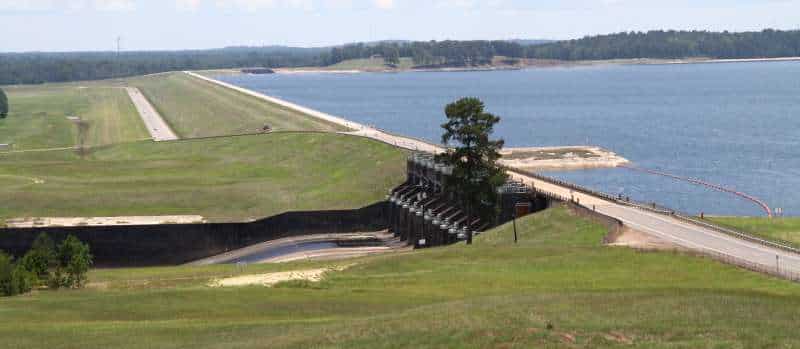
Sabine River Authority State of Louisiana – Observation Area near Toledo Bend Dam
9. Toledo Bend Lake, Louisiana and Texas
With a total area of about 205,000 acres in both Louisiana and Texas and providing water supply, hydroelectric power, and a plethora of recreational uses, Toledo Bend Lake is the largest human-made body of water in the south and the ninth largest in the United States. Impounded by the Toledo Bend Dam, Toledo Bend Reservoir has a storage capacity of 4,477,000 acre-feet, is 15 miles across at its widest point, has an average depth of 60 feet, is 1,264 miles of shoreline, and its two hydroelectric power generators have an estimated annual energy output of 205 million kilowatt-hours.
In 1949 and 1950 respectively, realizing a need to provide for the future, the Texas and Louisiana State Legislatures each formed their own Sabine River Authority in an effort to both conserve and develop the Sabine River Basin. In the 1950s, the two organizations worked together to come up with the idea of Toledo Bend Lake, and feasibility studies indicated that the project would be a success. Land acquisition and construction took place in the 1960s, and the project was completed in 1969. The total cost, including the land, dam and spillway, powerhouse, new roads and bridges, and the clearing of shorelines, was $70 million. Due to cooperation from investor-owned companies Gulf States Utilities Company, Louisiana Power and Light Company, and Central Louisiana Electric Company, the Toledo Bend Reservoir project did not have federal funding in its permanent financing – the only public water conservation and hydroelectric project to boast such a statistic.
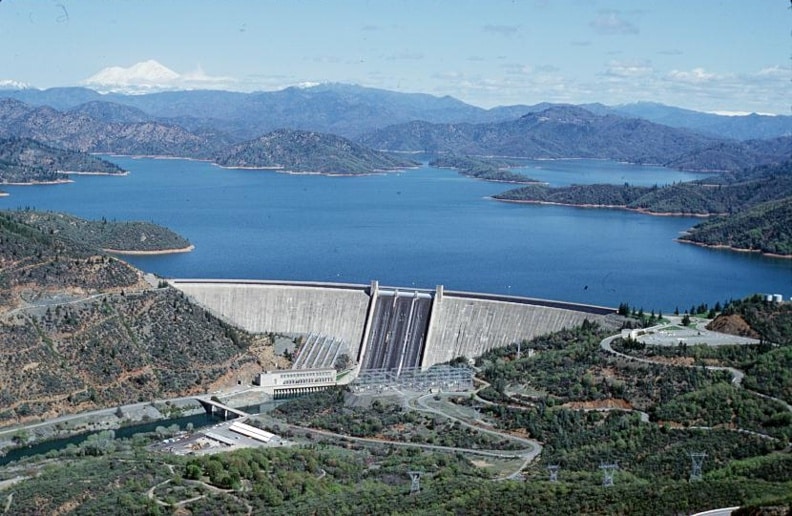
Shasta Dam, Lake Shasta
8. Lake Shasta, California
With a total capacity of 4,552,000 acre-feet, an elevation of 1,067 feet, 365 miles of mostly mountainous shoreline, and a maximum depth of 517 feet, Lake Shasta is California’s largest reservoir and the eighth largest in the United States. Lake Shasta is impounded by the Shasta Dam, a concrete arch gravity dam across the Sacramento River that stands 602 feet tall, making it the eighth tallest dam in the United States. Operated by the Bureau of Reclamation, the reservoir provides water storage, flood control, hydroelectricity, and protection against the intrusion of salt water.
The Shasta Power Plant contains five huge generators capable of producing 710 megawatts, and recent upgrades have increased their efficiency rating to 98%. Originally built to control the waters of the Sacramento, the McCloud, and the Pit Rivers, the reservoir has since become one of the most popular vacation spots in the western United States. Providing thousands of jobs for people still suffering from the Great Depression, construction on the dam began in 1935 and was completed in 1945.
Libby Dam, Lake Koocanusa
7. Lake Koocanusa, Montana
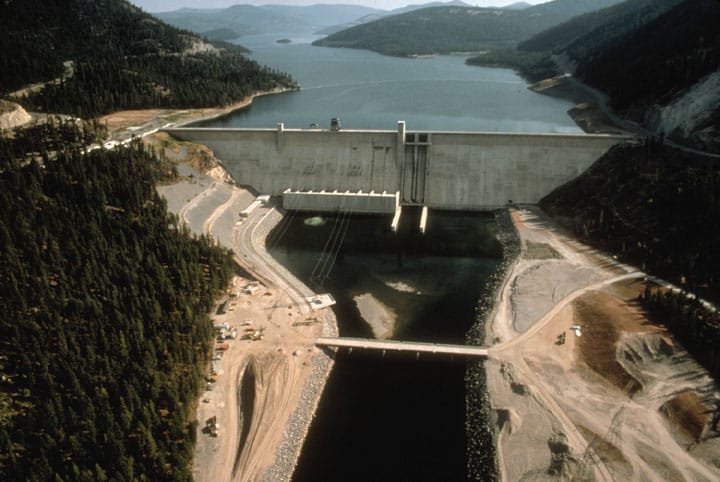
Impounded by the Libby Dam on the Kootenay River, Lake Koocanusa has a total capacity of 5,809,000 acre-feet, stretches 90 miles on the northern part of Montana and into British Columbia, Canada, and has a maximum depth of 370 feet. The reservoir provides water supply to both the United States and Canada, as well as hydroelectric power, flood protection, and wildlife habitat.
Operated by the Army Corps of Engineers in the United States, construction of the Libby Dam was a joint cooperative venture between the U.S. and Canada that began in 1966 and was completed in 1972. The Libby Dam is a concrete gravity dam that stands 422 feet tall and has a gated overflow spillway. The dam’s powerhouse contains five turbines and can generate up to 600 megawatts of power.
Grand Coulee Dam, Lake Franklin
6. Franklin D. Roosevelt Reservoir (Lake Franklin), Washington
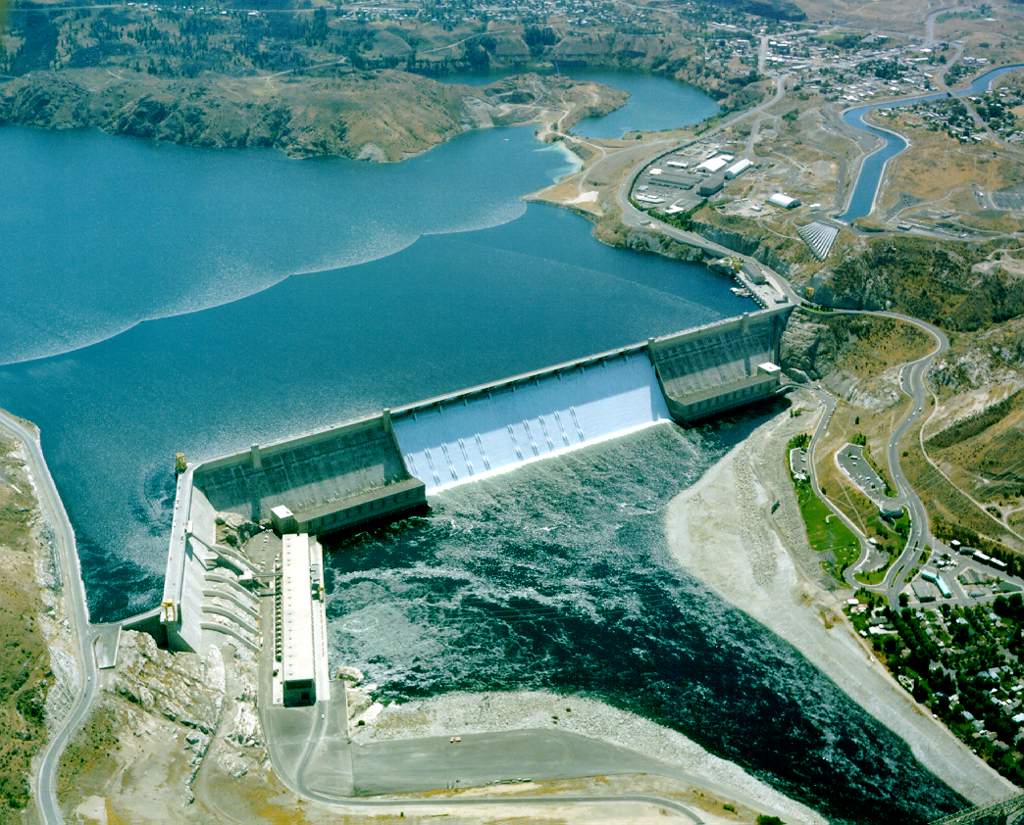
With a total capacity of 9,562,000 acre-feet, Lake Franklin is the largest reservoir and lake in Washington state and the sixth largest in the nation. Impounded by the Grand Coulee Dam on the Columbia River, Lake Franklin covers 125 square miles, has over 600 miles of shoreline, and stretches about 150 miles from the Canadian border to the Grand Coulee Dam. The reservoir provides water supply, hydroelectric power, wildlife habitat, and recreation.
Constructed between 1933 and 1941 and operated by the Bureau of Reclamation, the Grand Coulee dam is a concrete gravity dam that stands 550 feet tall, stretches almost one-mile long, and has a drum gate spillway. Originally constructed with two power plants, a third power station was added in 1974, and it is now the largest electric power-producing facility in the United States.
Fort Peck Dam, Fort Peck Lake
5. Fort Peck Lake, Montana
Boasting a 1,520-mile long shoreline that is longer than the entire coastline of California, Fort Peck Lake stretches 134 miles through central Montana, has a total capacity of 15,400,000 acre-feet, covers an area of approximately 245,000 acres, and has a maximum depth of 220 feet. Impounded by the Fort Peck Dam on the Missouri River, Fort Peck Lake provides water quality management, flood control, and hydroelectric power. It also lies within the Charles M. Russell National Wildlife Refuge and is home to a plethora of fish and game.
Operated by the Army Corps of Engineers, Fort Peck Dam was a major project of the Public Works Administration as part of the New Deal. The dam was constructed from 1933 to 1943 and the project employed tens of thousands of people. Fort Peck Dam is an art deco hydraulic earthfill dam that stands 250 feet tall, has a controlled overflow spillway with eight bulkhead gates, and has five generating units with a capacity of 185 megawatts. The dam was added to the National Register of Historic places in 1986 and is the largest hydraulically filled dam in the United States. It is also the second largest dam in the world by structure volume, second only to the Tarbela Dam in Pakistan.
Garrison Dam, Lake Sakakawea
4. Lake Sakakawea, North Dakota
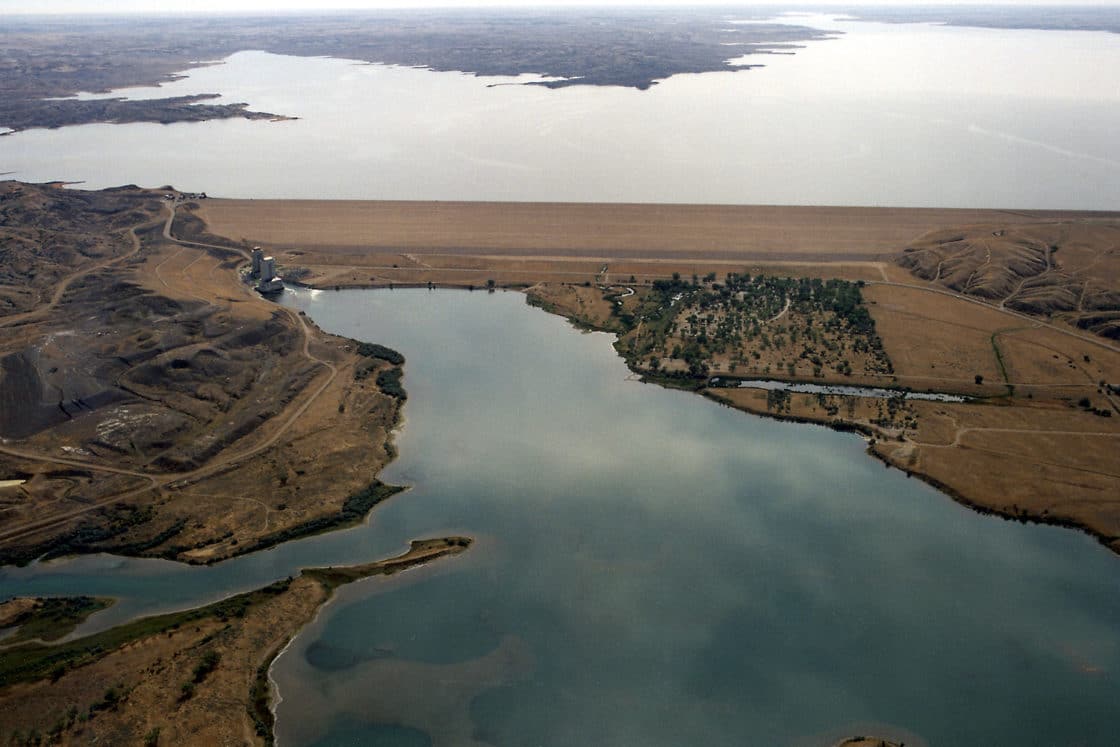
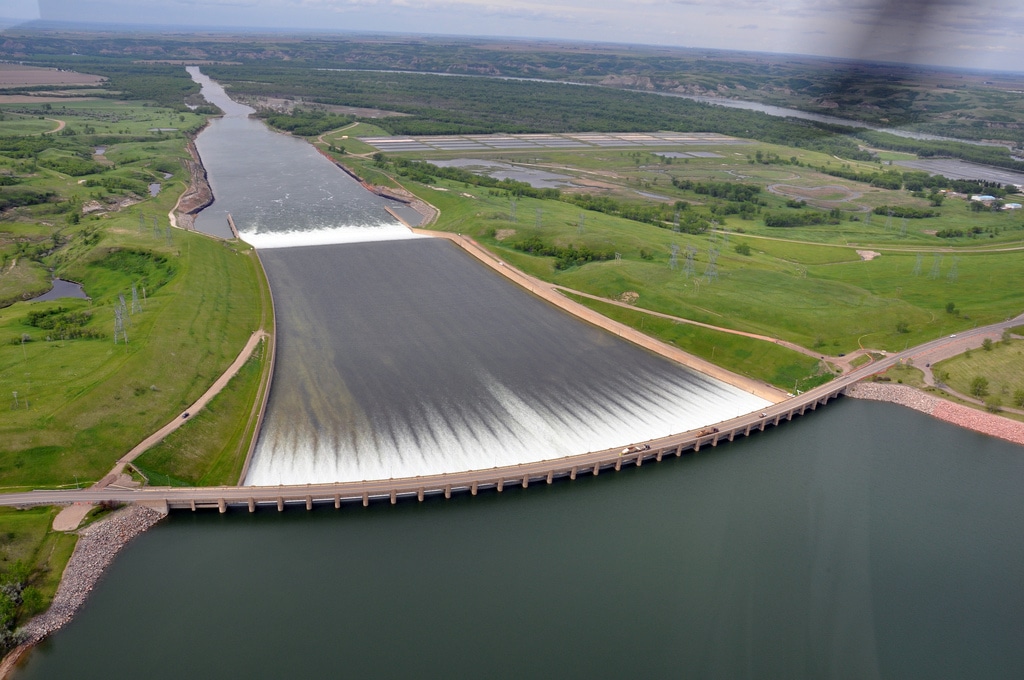
Impounded by the Garrison Dam on the Missouri River, Lake Sakakawea has a surface area of 307,000 acres, maximum depth of 180 feet, a shoreline of 1,320 miles, and a total capacity of 18,500,000 acre-feet. It is the largest human-made lake in North Dakota and the fourth largest in the United States. Originally constructed for flood control, navigation, irrigation, and hydroelectric power, the project was constructed by the Army Corps of Engineers between 1947 and 1953 and cost approximately $300 million.
Garrison Dam is an earthfill embankment dam that stretches almost two miles in length, stands 210 feet tall, generates 583 megawatts of power, and has a service spillway with 28 controlled gates. It is the fifth largest earthen dam in the world.
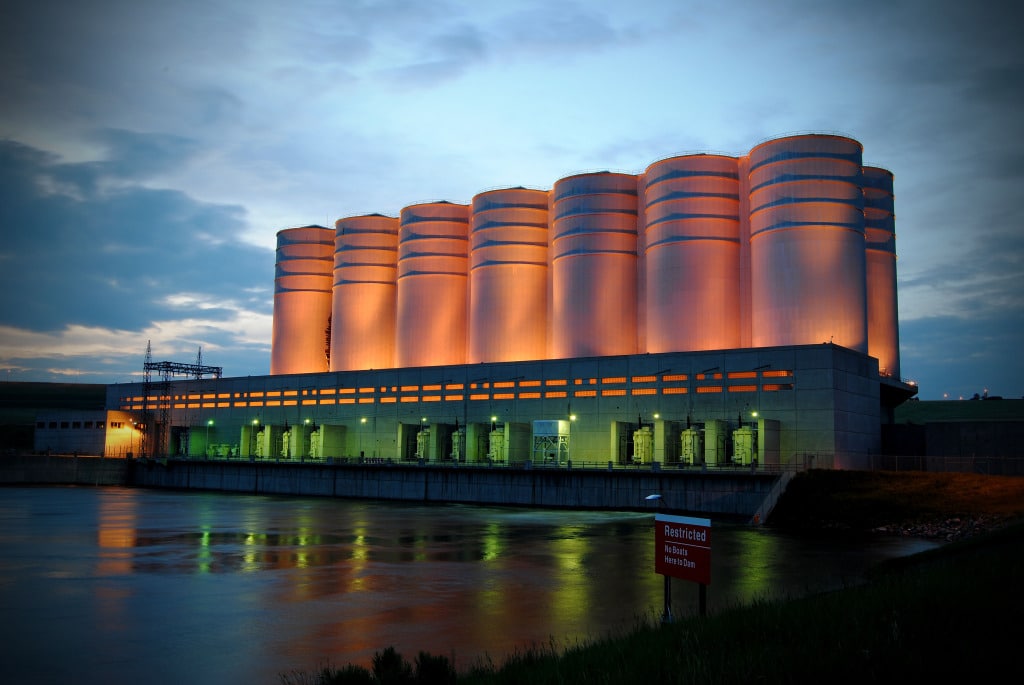
Oahe Dam at night, Lake Oahe; photo courtesy of Ashely Lieberman Hughes
3. Lake Oahe, South Dakota
With a surface area of 374,000 acres and a total capacity of 19,300,000 acre-feet, Lake Oahe stretches for 231 miles through South Dakota and is the third largest reservoir in the United States. It provides flood control, irrigation, hydroelectric power, recreation, wildlife habitat, and navigation benefits,
Authorized by the Flood Control Act of 1944, the Oahe Dam underwent construction in 1948 by the Army Corps of Engineers. In 1952, the world’s first rock tunnel boring machine (TBM) was invented specifically for the Oahe Dam project. The significance of James S. Robbins’ TBM invention cannot be overlooked, as it marked the beginning of machines replacing humans for tunneling. The earthfill dam, which is 245 feet tall and 9,360 feet long, impounds the Missouri River, has eight spillways, and is the fifth largest dam in the world by structure volume. The power station is capable of generating 768 megawatts of power and provides electricity for most of the north-central United States. The project, which was completed in 1962 at a total cost of approximately $340 million, was officially dedicated by President John F. Kennedy.
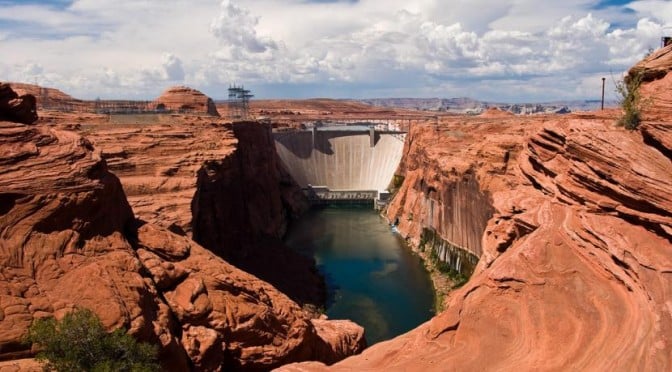
Glen Canyon Dam, Lake Powell
2. Lake Powell, Arizona
A breathtakingly beautiful reservoir that attracts over two million vacationers per year, Lake Powell is the second largest reservoir in the United States and is impounded by the Glen Canyon Dam on the Colorado River. Lake Powell — which has a capacity of 27,000,000 acre-feet, a surface area of over 161,000 acres, and a maximum depth of 532 feet — provides water storage for the Upper Basin states of the Colorado River Compact, including Colorado, Utah, Wyoming, and New Mexico.
Constructed at a cost of $155 million from 1956 to 1966 by the Bureau of Reclamation, the Glen Canyon Dam is a concrete arch gravity dam that stands 710 feet tall, contains over five million cubic yards of concrete, provides 1296 megawatts of power, and has twin concrete tunnel spillways controlled by double radial gates. The project was dedicated by Lady Bird Johnson on September 22, 1966.
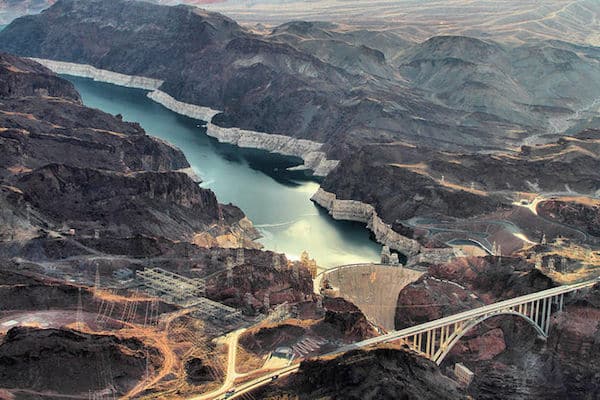
Hoover Dam, Lake Mead
1. Lake Mead, Nevada
Named after Bureau of Reclamation Commissioner Elwood Mead, Lake Mead is the largest reservoir in the United States, stretching 112 miles long with a total capacity of 28,255,000 acre-feet, a shoreline of 759 miles, and a maximum depth of 532 feet. It provides water supply, hydroelectric power, recreation, and wildlife habitat. Because of prolonged drought and increased demand, Lake Mead — which provides water to over 20 million people in the states of Arizona, Nevada, and California — has not actually reached its full capacity since 1983. In fact, Lake Sakakawea, number four on our list, currently lays claim to the title of largest reservoir by total area and water volume in reserve.
Constructed between 1931 and 1936 by the Bureau of Reclamation at a cost of $49 million, the Hoover Dam impounds the Colorado River to create Lake Mead. As impressive as the reservoir it creates, the Hoover Dam is a concrete gravity arch dam that soars a whopping 726 feet tall, has two controlled drum-gate spillways, and generates an impressive 2,080 megawatts of power. The construction provided jobs for thousands and thousands of workers during the Great Depression and was named, if somewhat controversially, after President Herbert Hoover. It is the second tallest dam in the United States, second only to the Oroville Dam in California.
Water and wastewater utilities across the country face common challenges. These include rising costs, aging infrastructure, increasingly stringent regulatory requirements, population changes, and a rapidly changing workforce. While many utilities find themselves turning from one urgent priority to the next, others have implemented effective operational efficiency initiatives that have helped them enhance the stewardship of their infrastructure, improve performance in many critical areas, and respond to current and future demands. Improved efficiency is not just beneficial to a utility’s bottom line – it benefits everyone in a community.
Infrastructure Stability
Utilities who implement operational efficiency understand the condition of and costs associated with critical infrastructure assets. This allows them to maintain and enhance the condition of their infrastructure over the long-term at the lowest possible life-cycle cost consistent with customer, community, anticipated growth, and system reliability goals. Efficient utility management assures infrastructure repair, rehabilitation, and replacement projects are coordinated in order to minimize disruptions in service or other negative consequences.
Enhanced Employee Leadership Development
A common problem facing many utilities today is a retiring work force. By implementing operational efficiency now, utilities can recruit and retain a workforce that is competent, adaptive, and correctly trained to take on leadership roles of their own. Through communication and effective training, utility owners and operators can create an organization focused on continual learning and improvement. This ensures employee knowledge is retained and improved upon. Over time, senior knowledge and best practices will be passed along to promote a well-coordinated senior leadership team who understands their system and the needs of its customers.
When employees or operators of water and wastewater systems are knowledgeable enough to solve problems themselves, it allows managers to focus more on the entire utility versus consistently fixing small problems. Managers are then free to focus on internal operations, better management practices, improving water and effluent quality, and other areas of priority.
Managing Reliable Data through Operational Efficiency
Coupled with excellent communication throughout utility staff, data collection is an area of operational efficiency that helps utilities meet demand and plan for the future. With the collection of accurate, reliable data and the tools to analyze the information, utilities can prioritize actions and capitalize on their efforts. This allows them to understand the demands of their service areas and ensure sufficient supply is available. By more efficiently identifying contributors to non-revenue water, such as system leaks, aging assets, and unauthorized usage, utilities can reduce operational expenses and uncover new revenue streams. They can also provide their customers with access to that same set of information, making it possible for them to understand and manage their consumption. This delivers benefits to the entire organization, including billing, customer service, operations, engineering, and distribution, and empowers utilities to address conservation and revenue opportunities.
Reduced Vulnerability to Climate Changes
Some practices that utilities are implementing greatly help to improve resiliency and reduce vulnerability to an ever changing climate. Internal practices and initiatives such as energy conservation, solar energy, and utilizing heat transformed into energy from sewage and digestion have helped utilities rely less on the grid and more on their own operations. This is especially beneficial considering the ever-increasing price of energy. Reducing energy use significantly lowers operational costs for utilities – freeing up dollars for future initiatives or infrastructure improvements. Utilities who practice operational efficiency understand that making internal practices more efficient results in the entire distribution system becoming more efficient.
All Around Flexibility for Utilities
Practicing operational efficiency can greatly improve all around flexibility for water and wastewater systems. Knowing your distribution system and operating it to your specific community’s needs is a huge advantage in dealing with costly dilemmas that occur with infrastructure. In places that see seasonal spikes in water usage, operational efficiency allows a utility to adjust and operate more effectively during peak times as well as during the “off-season.” Practicing operational efficiency also allows a utility to better deal with issues in their distribution system without disrupting service to customers.
In Conclusion
To meet continually increasing challenges, utilities must become more efficient in the way they manage their resources, address demands on their infrastructure, and monitor data throughout their systems. The implementation of improved operational efficiency helps utilities ensure ongoing, timely, cost-effective, reliable, and sustainable performance improvements in all facets of its operations.
The 8.4 mgd dissolved air flotation (DAF) Long Pond Water Treatment Plant construction progression video courtesy of Methuen Construction Company, Inc. For detailed information on the project, please visit here.
As of August 7, 2017, MassDEP’s closure requirement 310 CMR 80.15 mandates all single-walled steel underground storage tanks (USTs) to be closed-in-place or removed. Covered under this regulation are tanks and associated piping that have more than ten percent of their volume underground and hold petroleum products or hazardous substances listed in the U.S. Comprehensive Environmental Response Compensation Liability Act. With the deadline now less than one year away, it is important to fully understand single-walled USTs, their potentially harmful impact on the environment, and how to properly plan to remove them.
Single-Walled USTs Explained
USTs have been used for many years to store hazardous substances and petroleum products used by a wide variety of businesses. In addition to the tank itself, a “UST system” includes the underground piping that is used to fill the tank and draw product from it. Until the mid-1980s, most USTs were made of bare steel, which is likely to corrode and leak over time. These leaks can exist undetected for years and cause pollution of the surrounding soil and even groundwater. The piping in the system can also leak if not properly installed and maintained. In many cases, contaminant leaks do not get discovered until the owner or operator realizes that a significant amount of product in a tank goes missing or when the tank is removed and contaminants are found in the underlying soil. Another indication of a leaking UST is neighbors complaining of odors in their buildings or experiencing problems with their drinking water.
Leaking USTs, specifically single-walled steel USTs, have caused considerable environmental damage in Massachusetts, affecting public and private water supplies, wetlands, and soil. In some cases, vapors from contaminated soil and water have permeated homes and businesses. Many millions of dollars have already been spent on cleaning up these leaks, but fully protecting public health and the environment from UST leaks relies on removing or closing the storage tanks altogether.
Benefits of the MassDEP UST Removal Requirements
The site of a former gas station transformed into a pocket park in Hamilton, Ohio. Photo courtesy of https://www.journal-news.com
The removal or permanent closure of aging, single-walled USTs benefits many areas of a community. The new MassDEP regulations will benefit human health, ecosystem functions, and land productivity.
Human health benefits are among the top reasons why single-walled USTs are now required to be removed by August 7, 2017. Contaminated well water and vapor intrusion are the most critical threats to human health from failing USTs. Leaks from USTs can endanger residents for miles through contamination of groundwater, and increased cancer rates and blood disorders have been attributed to exposure to petroleum products, which are commonly found in USTs. The petroleum vapors which are emitted are highly flammable and are potentially dangerous when found in people’s homes. Vapors can travel through soil, sewer lines, storm drainage systems, and other pathways to enter homes and other buildings.
Many single-walled USTs are located in old gas stations, providing the opportunity to add aesthetic and ecological benefits to a community. If a UST leaks into soil, the site becomes contaminated and is considered a brownfield. Removing or closing USTs and making the site usable again decreases the need for development elsewhere and helps preserve greenfields, such as pastures or forests. Many old gas stations are situated in quite visible locations within towns or neighborhoods and can be reused for purposes such as gateways, town centers, or pocket parks. Such redevelopment opportunities improve a locality’s appeal and create recreational value.
Removing or closing-in-place single-walled USTs results in several ecological benefits. Preventing leakage of hazardous material can reduce surface water contamination – protecting fish and other wildlife. Below the ground, removing USTs ensures that leaking tanks will not compromise underground aquifers for future generations. In the long run, this will better protect our drinking water’s taste and purity. Removing USTs also greatly improves land use because former UST sites with a “clean bill of health” will be more likely to develop and prosper without environmental restrictions.
Are there any exceptions to the new regulations?
Soil contamination from a UST which leaked hundreds of gallons of oil. Photo courtesy of https://mde.maryland.gov
The MassDEP has included exceptions to the UST removal regulations. Tanks are not required to be removed or closed-in-place if they are consumptive use tanks – such as for heating oil in homes – and single-walled tanks that were relined prior to August 8, 2007 in accordance with API 1631. For these relined tanks to be exempt, the owner or operator must possess a permit and approval issued by the head of the local fire department, or a current legally valid warranty for relining. Other exceptions to the new regulations include single-walled steel tanks that have been wrapped with fiberglass, aramid, carbon fiber, or plastic compounds. It is important to note that single-walled steel tanks that are temporarily out-of-service are NOT exempt from the closure requirement, even if they are consumptive tanks for onsite usage. USTs that are not actively used or temporarily out of service are considered abandoned and must be removed or closed-in-place by August 7, 2017.
MassDEP’s UST closure regulation allows tanks to be permanently closed-in-place only if they cannot be removed from the ground without removing a building, or the removal would endanger the structural integrity of another UST, structure, underground piping, or underground utilities. When closing a tank in place, it is required to clean all contaminants out of the tank to prevent future leaks.
In Conclusion
Meeting MassDEP’s closure requirements means more than just being up to code. Removing hazardous USTs benefits everyone involved. It improves a property’s environmental footprint, removes high risk conditions, and reduces an owner’s environmental liability. Compared to the cost of cleaning up hazardous materials after a UST leak, removing a single-walled UST is well worth it. There is only one year left to comply with the MassDEP UST regulations, so it is imperative to start planning now to remove or close-in-place your single-walled USTs.
Please feel free to contact us for any questions on MassDEP’s requirement or for assistance with UST removals and closures.
In honor of International Beer Day, we are taking a look at what breweries are doing to conserve the number one ingredient in brewing beer: water. Due to water shortages, increased demand, and heightened awareness, many breweries have taken steps to increase water efficiency and to implement water saving techniques in their brewing. Utilizing a myriad of methodologies and technologies, an increasing number of today’s breweries have begun to focus on brewing beer with water efficiency and conservation at the forefront of their business.
Anheuser-Busch InBev
The undisputed behemoth of the beer world with 25% of the global beer market, Anheuser-Busch InBev has implemented water-saving measures in many ways. Some of its plants use reclaimed water for equipment cleaning, irrigation, firefighting, and other local uses, such as watering a soccer field in Peru and manufacturing bricks in Brazil. And, as would be expected from such an enormous, influential company, Anheuser-Busch InBev is piloting agricultural programs that it hopes will spread to all facets of agriculture. To start, they have initiated a “Smart Barley” program with 2,000 barley growers in Idaho and Montana. Since agriculture accounts for 95% of the water used in beer making, increasing agricultural water efficiency is the key to breweries becoming better water stewards. Utilizing sensors in the field, cooperative programs, and its own hybridized, drought-resistant seeds, Anheuser-Busch InBev hopes to decrease agricultural water usage by 25% over the next two years.
Even before the implementation of its agricultural program, Anheuser-Busch InBev had managed to reduce its water footprint to the point that it now uses less water than any other major brewer. As of this writing, the company uses about 3.2 bottles of water for each bottle of beer, and the industry average is seven bottles of water per each bottle of beer. In fact, from 2013-2014, Anheuser-Busch InBev saved as much water as is used in the manufacture of four billion cans of Budweiser.
MillerCoors
Barley requires 237 gallons of water per every pound grown
MillerCoors is also a giant in the beer industry with 30% of the American beer market. Like its major competitor Anheuser-Busch InBev, it also has an Idaho-based pilot project called the Showcase Barley Farm in Silver Creek Valley, Idaho. Utilizing precise irrigation techniques and hardier crop planting, MillerCoors is researching the best ways to increase its water efficiency. Already a success in 2011, Showcase Farms saw a 9% reduction in water usage by precision irrigation alone.
MillerCoors has also implemented water efficiency and conservation measures at its breweries such as utilizing recirculated water rather than freshwater for cooling, reusing wastewater for non-potable uses, cleaning cans with ionized air rather than water, sanitizing systems with bleach instead of hot water, and installing waterless lubrications throughout their operations. The water reclamation system in their Milwaukee brewery alone saves 100 million gallons of water per year. The company uses 3.53 bottles of water for each bottle of beer it produces — just a tad more than Anheuser-Busch InBev — but it hopes to slash its water footprint an additional 15% by 2020.
Both Anheuser-Busch InBev and MillerCoors have made huge strides towards water efficiency, and because of their massive size, the impact is significant. However, many smaller craft breweries are doing just as much — and in many instances, more — to become water and environmental stewards.
Full Sail Brewing Company
Oregon-based Full Sail Brewing Company is fully committed to water conservation. They operate a hot water recovery system that saves over three million gallons of water per year. Employees work four ten-hour days, which saves another three million gallons of water per year. They have installed special filters to maximize malt extract while minimizing water usage, they’ve reduced spray nozzle apertures on bottle and keg washers, and they’ve reduced cooling water usage by adding a glycol chiller in tandem with their heat exchanger. These measures save an additional 4.1 million gallons per year. The result? The forward thinking company uses just 2.5 bottles of water for each bottle of beer produced — the lowest ratio we have found. But they don’t stop there. Full Sail Brewing operates its own voluntary wastewater treatment plant, which reduces the load to the municipal treatment plant by pre-treating the wastewater. In addition, they distribute their treatment plant’s biosolids to local farmers and an orchardist for fertilizer.
Cape Cod Beer
Hyannis, Massachusetts-based Cape Cod Beer utilizes water reclamation and conservation efforts in their brewing, but they take it a step further. Their beers are only sold in refillable kegs or growlers, and they are passionate about recycling. In addition, they donate all used and leftover grain to local farmers for feed or compost, and they were recently certified “Cape & Islands Green” Level 1.
California Brewers
Photo by Kerrie Lindecker The City of Cloverdale celebrated the completion of two new wells during a ribbon cutting
Bear Republic Brewing Company, whose corporate office and larger brew house are located in Cloverdale, California, actually partnered with the City of Cloverdale to dig two new water wells, which went online last August. Because the City didn’t have the funds for the new wells, Bear Republic prepaid several years of its water fees — $466,000 — in order to allow the city to complete the project on time and under budget. Bear Republic also conducts regular audits for leaks, practices conservation and reclamation in its operations, and is installing a wastewater pre-treatment plant that will generate heat and electricity with the methane it produces as well as reclaimed water for irrigation and cleaning.
In Escondido, California, the nation’s tenth largest craft brewer, Stone Brewing Company, treats all of their brewing wastewater — not to be confused with restaurant or restroom wastewater — with an aerobic digestion and filtration process. The reused water is pure and they use it for cleaning. “From a good brewing practices standpoint, it’s good to watch water usage, especially when you live in a dry area like we do,” explained Mitch Steele, Stone’s Brew master. He also added that they test the reclaimed water frequently and that, if regulations allowed, he wouldn’t hesitate to drink it.
Adding to their already environmentally friendly business practices, both Stone Brewing and Bear Republic have been proactive in sharing their practices and knowledge with the rest of the craft beer community through webinars and on-site tours.
Brewers for Clean Water
So far, over 50 craft breweries, including eight New England breweries, have joined the National Resource Defense Council’s Brewers for Clean Water initiative. The program aims to spread awareness of the Clean Water Act and to support initiatives that protect and conserve our nation’s water. “As we continue to see the craft beer segment grow, we as brewers owe it to the communities we live, work, and play in to be mindful of protecting our waterways as we strive for growth that is environmentally and socially responsible now and down the road,” said Mat Stronger of Allagash Brewing Company, a Portland, Maine-based brewery that is active in the Brewers for Clean Water initiative.
Jester King Brewing with Harvested Rainwater
Jester King’s rainwater collection tanks
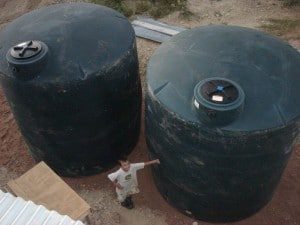
Austin, Texas-based Jester King Brewery recently purchased 3,000-gallon rain water collection tanks that will collect rainwater from the roof of both their brewery and adjacent beer hall. They expect to capture an estimated 10,000 barrels of rainwater per year that will be disinfected using ultraviolet and reverse osmosis purification and then be used in their brewing process.
Beer Made with 100% Reclaimed Water
Clean Water Services, a wastewater treatment utility that serves the Portland, Oregon metro area, asked for approval from the state to allow members of the “Oregon Brew Crew” to use recycled sewage water from its Forest Grove plant for beer-making. They received initial approval from the Oregon Environmental Quality Commission and the Oregon Health Authority, but will need further approval for a recycled water reuse plan before forging ahead. Last year, the Oregon Brew Crew produced test batches of beer made from 30% reclaimed water, which met with rave reviews. But, according to the dozen brewers, using 100% reclaimed water will be a more exciting challenge.
“I’m trying to think of a really cool recipe. When they told us 100 percent we’re like oh man, first the names, then the recipe comes later. And I’m excited,” said Lee Hedgmon, president of the Oregon Brew Crew.
Clean Water Services believes that educating the public about recycled water will lead to its ultimate acceptance, and they don’t think there’s any better way to start that conversation than with beer.
Sewage Beer
Really. It’s called Activated Sludge, has a radiation symbol on its label, and is brewed with purified Milwaukee Metropolitan Sewerage District wastewater plant effluent that has NOT gone through the final cleaning process typically necessary for potable reclaimed water.
Theera Ratarasarn, a wastewater engineer with the Wisconsin Department of Natural Resources, enjoys home-brewing beer to relax after his two young sons have gone to bed. After doing some thinking, he decided he wanted to raise awareness of the quality of plant effluent, and figured the best way to do so was with his evening hobby.
“I wanted to get people talking,” he said “There’s a potential use for what we discharge into lakes and streams.”
Ratarasarn filtered, treated, distilled, and tested the water before beginning to make five gallons of his Activated Sludge, a wheat ale with 5.15% alcohol by volume. And then came the true test. Ratarasarn presented his sewage brew to a taste panel at Lakefront Brewery, where Activated Sludge competed against Lakefront Wheat Monkey. The result? “It’s one of the better home brews I’ve ever had,” stated Mitchel De Santis, who graded the beer a seven out of ten.
“Everybody I talk to wants one,” added Ratarasarn.
Brewing Up Water Efficiency
Breweries are some of the largest consumers of water, yet have proven that they are some of the most active conservationists. We’ve heard it before: everyone loves beer, so it is an easy way to spread awareness, start conversation, and implement efficiency and conservation techniques. While we may not be drinking sewage beer any time soon, we can all agree that U.S. breweries are doing their part in the water conservation effort — and that’s something to which we can raise a toast. Happy International Beer Day!
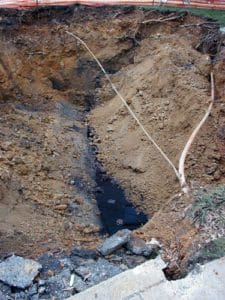
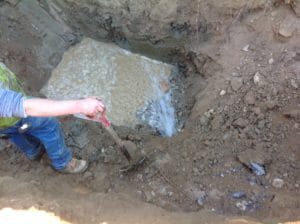
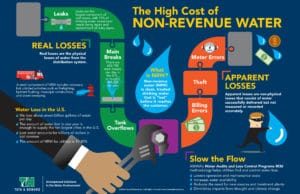
Physical losses such as leaking or broken water mains are known as real losses. There are about 240,000 water main breaks per year in the US.
Every day, United States utilities lose around seven billion gallons of clean, treated drinking water. This “lost” water, referred to as non-revenue water (NRW), is caused by a number of factors, including leaking pipes, water main breaks, theft, and improper accounting of water. In fact, we lose enough water each year to supply our ten largest cities. Of the estimated $200 billion needed over the next 20 years to upgrade our water distribution systems, $97 billion is needed for water loss control. With water crises occurring throughout the country, NRW is a big deal.
How NRW Affects You
Non-revenue water affects everyone in a water distribution system. Although it is considered “non-revenue” water, many utilities include these costs in their rates, which is reflected in your bill. The less NRW a water utility produces, the lower its total costs will be. And let’s face it: no one wants to pay for things they don’t use. Also, a lower percentage of NRW reflects positively on your local water utility’s performance. Utilities with low NRW percentages typically perform well at replacing broken water mains and meters, and defending against theft.
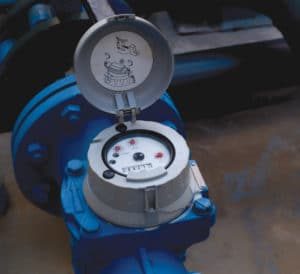
Metering errors, theft, and billing errors result in water “appearing” to be lost. These non-physical losses are called apparent losses.
When water leaks from pipes, it can erode the subsurface underneath roads and other public
infrastructure. When the erosion reaches a critical point, the road collapses or a building’s foundation can fail. The better your water utility performs in NRW reduction, the less likely your community will need to replace its public infrastructure, especially roads. Our population is continuously growing and without improved efficiency, water supply expansion and treatment projects will be necessary — significantly increasing the cost of water. Improving water use efficiency by reducing NRW defers the expense of water supply expansion and treatment. If we can prevent clean, treated water from getting “lost,” there will be less of a need to find new sources or increase capacity.
Leaking pipes contributing to non-revenue water also can pose a health risk to communities. Contaminated groundwater from leaking sewage or pollution can find its way into drinking water pipes during low pressure events. Contaminated drinking water then has the potential to spread disease and other harmful substances.
Water Audits and NRW
Infographic of the high costs of NRW. Click the image to see it full size.
The best way to reduce a utility’s NRW is through routine water audits. Most utilities in the U.S. conduct infrequent water audits and, therefore, are likely suffering substantial losses without even being aware of it. Since 2005, a number of state and regional water resource agencies in the United States have established water audit reporting requirements for water utilities. In addition, the American Water Works Association (AWWA) has developed and published a methodology for identifying and controlling NRW, M36 Water Audits and Loss Control Programs, now in its fourth edition. Tata & Howard Vice President Steve Rupar, P.E. co-authored chapters 4 and 5 of the new M36 manual, which focus on the causes of apparent loss and what can be done to control it. An expert in water loss control, Steve has also given presentations and a webinar on the subject, which can be found here. Water audits help utilities identify the causes and costs associated with water loss, and develop strategies to avoid NRW. They also help to identify areas of a distribution system requiring repairs or maintenance. Water audits are important, especially in the northeast, where some infrastructure is over 100 years old. Preventing NRW helps save our infrastructure, our money, and most importantly, our water.
In Conclusion
NRW affects everyone, and it’s important to monitor and continuously improve water distribution systems. Water audits are a vital step toward reducing lost water while improving water infrastructure. We lose billions of dollars every year to NRW — money that could be used to improve our infrastructure or to support other clean water initiatives. Water lost is water and money wasted, and the less NRW a utility has, the better off it — and its customers — will be.
Recently in the news, we have heard a lot about the nationwide lead in drinking water crisis and the need to update our aging infrastructure. In addition, the plight of the people living in Navajo Nation has been brought to the nation’s attention after being showcased in a video by CBS Sunday Morning News. However, there is yet another very serious water crisis in the United States that has garnered very little media attention, and this week, we will be concluding our four-part series on water crises in the United States by talking about colonias.
What Are Colonias?
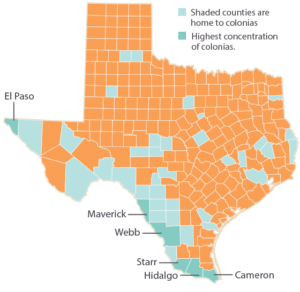
Colonia translates to neighborhood in Spanish, and in the United States, colonias are primarily Hispanic neighborhoods found along the Mexican border in Arizona, California, New Mexico, and Texas. With over 2,200 colonias, Texas has by far the most colonias in the nation, as well as the largest colonia population with over 500,000 residents. The modern-day colonia population is about 96% Mexican-American, with about 74% of those — and 94% of colonia children — being American citizens.
A Texas colonia residence
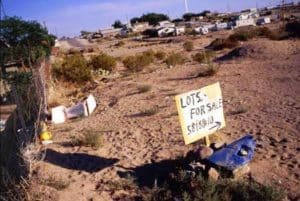
Colonias originated in the 1950s. At this time, less than honorable developers bought up worthless land along the Mexican border — such as land that was agriculturally useless or located in flood plains — parceled it into tiny lots with little to no infrastructure and sold it off to low-income immigrants in search of affordable housing. To this day, colonias are often bought through a contract for deed, which is a questionable financing method by which developers offer low down and monthly payments with a very high interest rate and no title until the loan is paid in full. Prior to 1995, developers did not typically record the transactions with the county clerk, leaving the buyer with virtually no rights. If they fell behind on payments, the developer could repossess the property quickly, usually within just 45 days, without going through the foreclosure process.
Fortunately, Texas passed the Colonias Fair Land Sales Act in 1995 to somewhat protect colonia residents who are forced to finance through a contract for deed. The Act requires developers to record the contract with the county clerk and to provide property owners with an annual statement that shows the amount paid towards the loan and taxes as well as the number of remaining payments. The Act also forces developers to itemize which services, such as water, wastewater, and electricity, are available, and whether the land is located in a flood plain.
While the Colonias Fair Land and Sales Act has improved contract for deed sales, there remain serious problems. Because property owners do not actually own the land or have a title, they cannot secure any type of financing that uses the property as collateral. Considering that colonia residents are typically well below the poverty level, any other types of financing are also unavailable to them, making it impossible to improve their property. Therefore, colonia residents typically construct their homes in drawn out phases as funds become available to them. Because of this, colonia homes often do not have electricity or even basic plumbing.
Challenges in Colonias
Arguably the most serious challenge facing colonias is the lack of improved water and sanitation services. Many colonias do not have public sewer systems and instead rely on rudimentary septic systems or outhouses that are often inadequate and overflow. And because the land is frequently in flood plains with poorly constructed roads that do not properly drain, sewage collects and pools, rife with bacteria and pathogens. Even colonias that do have sewer systems typically lack any type of wastewater treatment. Therefore, untreated wastewater is discharged into local streams that flow directly into the Rio Grande or the Gulf of Mexico.
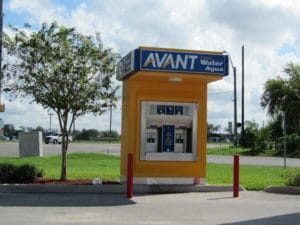
Vending machine in Hidalgo, Image courtesy Wendy Jepson www.wendyjepson.net
Potable water also presents a challenge to colonia residents. Very often, inhabitants must buy water in drums to meet their needs, or, even worse, they utilize untreated water from wells that are contaminated. Some private companies have installed water “vending machines” that provide bottled water at an astronomical cost to residents who can ill afford it. Even colonias that do have water lines have major problems, because residents are unable to tie-in due to their homes not meeting county building codes; to meet the building codes, they need to have adequate plumbing — a true Catch-22 situation. In fact, housing in colonias is typically considered dilapidated by local inspectors. Residents often start with just tents, cardboard, and lean-tos, and make improvements little by little as funds allow.
Due to the lack of improved water and sanitation, as well as lack of electrical services, it should come as little surprise that health conditions in colonias are often deplorable. Hepatitis A, dysentery, tuberculosis, cholera, salmonella, and other diseases occur at an astronomically higher rate in colonias than they do in the rest of Texas, according to Texas Department of Health data. To make matters worse, most colonias do not have local medical services and have a serious shortage of primary care providers, and most colonia residents lack health insurance. Therefore, the average age of colonia residents is only 27 — a full 10 years younger than the national average. And, just as is the case in Africa and other developing areas, quality of health is directly linked to quality of education. Therefore, many colonia residents remain undereducated — 55% of residents do not have a high school diploma — causing the cycle of poverty to continue generationally. The unemployment rate in colonias is anywhere from 20-60%, compared with 7% for the rest of Texas.
Assistance to Colonias
Thankfully, through a series of public outreach initiatives, more attention has been brought to the existence of colonias and the third-world conditions in them. In the last 20 years, the Texas Secretary of State has been recording the infrastructure, or lack thereof, within colonias and providing a significant amount of funding — tens of millions of dollars — to improve these areas. And it is working, albeit slowly. Since 2006, about 100 colonias have been moved out of the “red” category, indicating the worst conditions. However, with over 2,200 colonias along the Texas-Mexico border, there is still much work to be done.
On a federal level, USDA Rural Development has grants available through the Individual Water and Wastewater Program for households residing in an area recognized as a colonia before October 1, 1989. The colonia must be located in a rural area and determined to be a colonia on the basis of objective criteria including lack of potable water supply, lack of adequate sewage systems, lack of decent, safe and sanitary housing, and inadequate roads and drainage. Grant funds may be used to connect service lines to a residence, pay utility hook-up fees, install plumbing and related fixtures like a bathroom sink, bathtub or shower, commode, kitchen sink, water heater, outside spigot, or bathroom, if lacking. Qualifying applicants must own and occupy their home, show income from all individuals residing in the home below the most recent poverty income guidelines, and not be delinquent on any Federal debt. The maximum individual grant for water systems is $3,500 and for wastewater is $4,000 with a lifetime assistance maximum not to exceed $5,000 per individual. Further information can be found on USDA’s web site. In addition, the United States Department of Housing and Urban Development (HUD) in Texas, Arizona, California, and New Mexico has set aside up to 10 percent of their State Community Development Block Grant Program (CDBG) funds for improving living conditions for colonias residents.
Leticia Jones has received several business loans from LiftFund and now the future of her catering business is bright. Image courtesy dallasfed.org
Fortunately, colonia residents are a very resourceful, tight knit group who are willing to work together and help each other, and some private and non-profit institutions have also become involved in the plight of colonia residents. For example, Texas A&M worked with residents on a water filtration project which involved making simple filters to make water potable. In addition, a non-profit lender called the LiftFund has provided loans to some colonia residents to assist them with starting a business. These loans have a very low interest rate and are given to people who cannot qualify for a traditional loan. Colonia residents are very often entrepreneurial in spirit, perhaps through necessity. After all, for years they have done what they need to do to get by, whether it be selling handmade crafts at flea markets or cutting up tires dumped along colonia roads and turning them into unique flower pots.
In Conclusion
Colonias are a little known part of America that have conditions oftentimes no better than those found in developing countries. One of the biggest causes of generational poverty in colonias is attributed to lack of basic water and sanitation services, causing health and education issues. Just like the plight of the people living in Navajo Nation, it is shameful that people living in the richest land in the world do not have access to these basic human rights. Add to this the lack of charitable organizations supporting water poverty in the United States, and colonias qualify as one of the most significant, and heartbreaking, water crises in the nation.
Let's stay in touch.
Get the latest news, blogs, and insights conveniently in your inbox.

 Imagine a day without water. Nearly every single thing we do is reliant on water. Right at the start of our day, we would not be able to use the bathroom, take a shower, brush our teeth, or make a cup of coffee. There would be no cleaning dishes, mopping floors, or cooking food. Water is something we use constantly throughout the day without even thinking about it, and has therefore become something we take for granted. For that reason, Imagine a Day Without Water was first introduced in 2015 in order to bring awareness to the value of water.
 Think about the way water enters our homes and businesses, and of how our wastewater leaves it. There are literally thousands of pipes underground that we never see, and many of these pipes are approaching the end of their useful life. After all, most of our infrastructure was built around the time of World War II, and is now over 70 years old. In fact, much of the infrastructure in New England is well over 100 years old. These pipes and treatment plants are in desperate need of repair and replacement. In addition, our drinking water is treated to meet increasingly stringent regulations that protect our health. Bacteria, toxins, metals, and other harmful substances are all removed from the water prior to it entering the distribution system, and this treatment is expensive. In the same way, the wastewater that leaves our homes and businesses is highly treated and cleaned before it is returned to the environment, protecting public health from the myriad toxins and diseases found in untreated wastewater.
 Another challenge faced by utilities today is our growing national population combined with historic drought and climate change. This increased demand in the wake of a dwindling supply is placing extra pressure on our water and wastewater systems, and requires thoughtful, long-term solutions if we are going to be able to meet current and future demands. Add to that the recent focus on our nation’s lead service lines and the fact that they absolutely need to be replaced, and it becomes clear that our water and wastewater systems are in desperate need of attention — and investment.
 We have reached the point where we must proactively address and invest in our nation’s water and wastewater infrastructure — before it is too late. Imagine a Day Without Water is a day in which we can all spread the word about the value of water by encouraging friends, family, and colleagues to imagine what their lives would be like without water. With proper planning and smart investment from both consumers and our legislators, living without water is something that will never come to fruition in our nation. Join the movement today by participating in Imagine a Day Without Water. For the many no-cost ways in which you can participate, including signing a petition, joining a Thunderclap, and becoming involved on social media, please visit https://imagineadaywithoutwater.org/participate.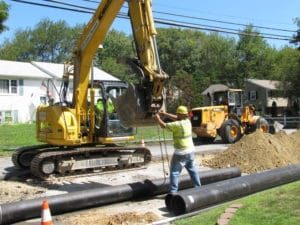
 While utilities are working diligently to keep our nation’s water lead-free, public schools have recently come under fire, as schools from cities across the nation — including Boston, Massachusetts; Ithaca, New York; Portland, Oregon; and Tacoma, Washington — have found lead in their drinking water above the EPA’s action level of 15 parts per billion. Surprisingly, this contamination is the result of a legal loophole that many states are looking to close: schools are mandated by the EPA to be connected to a water supply that is regularly tested for lead and other contaminants; however, these utilities are not typically required to actually test the water inside the schools themselves. Considering that the average age of a school in the United States is 44 years old, it should come as no surprise that there are elevated levels of lead in the drinking water of public schools. After all, lead pipes were legal until about 30 years ago, and faucets and fixtures were allowed to contain up to 8% lead until 2014.
 Many states have introduced legislation this year that would require public schools to regularly test their water. Bills on the table in Michigan, New Jersey, North Carolina, and Rhode Island would require regular testing, as would a New York bill that takes it one step further by providing funding for said testing. In addition, the New York bill would require schools to notify parents and to provide an alternate supply of safe drinking water to students if elevated lead levels are found. In Massachusetts, all community water systems are required by Massachusetts drinking water regulations to collect lead and copper samples from at least two schools or early education and care program facilities that they serve in each sampling period, when they collect their Lead and Copper Rule (LCR) samples. In addition, in April of 2016, it was announced that $2 million from the Massachusetts Clean Water Trust (MCWT) will fund cooperative efforts to help Massachusetts public schools test for lead and copper in drinking water. The funds, to be used by the Massachusetts Department of Environmental Protection (MassDEP), will provide technical assistance to ensure that public school districts can sample the taps and water fountains in their schools, and to identify any results that show lead and copper contamination over the action level. On a federal level, legislation has been introduced to Congress that would requires states to assist schools with testing for lead; however, it does not provide funding.
 World Water Week in Stockholm is an annual event that focuses on global water issues. One of the key aspects of World Water Week is the coming together of industry experts in an effort to brainstorm and develop solutions to the world’s most pressing water-related issues.
 Agriculture is not only critical to nourishing the global population, it is also far and away the most aggressive consumer of water. In fact, 70% of water withdrawals worldwide are for agriculture. Add to this the fact that by 2050 global agriculture will need to produce 60% more food in order to feed the burgeoning population, and it becomes clear that finding ways to farm sustainably is not only prudent, but necessary. The most sustainable form of agriculture comes in the form of rain fed crops. However, only about half of agriculture that has the potential to be rain fed is currently doing so. The rest is relying on irrigation and water withdrawals. Therefore, a key goal for the future is to convert these irrigated crops into ones that are watered naturally, with rainfall.
 Domestic usage only accounts for 10% of total water demand, but its impacts are arguably the most important. Lack of improved water and sanitation is one of the largest contributors to poverty, illness, and lack of education worldwide. Even with the incredible strides made in the United Nation’s goal to provide improved water and sanitation to all people, an estimated 748 million people still lack access to an improved source of water and 2.5 billion still lack access to improved sanitation. One of the key goals of water for sustainable growth is finding ways in which to unequivocally ensure safe, clean water and hygienic, private sanitation to all inhabitants on the planet.
 Currently, over half of the global population resides in cities, and that number is expected to increase to over two-thirds of the nine billion global inhabitants by 2050. Most of this increase will happen in developed nations, which will tax infrastructure and likely increase areas of impoverished living conditions. Already in the United States are areas, such as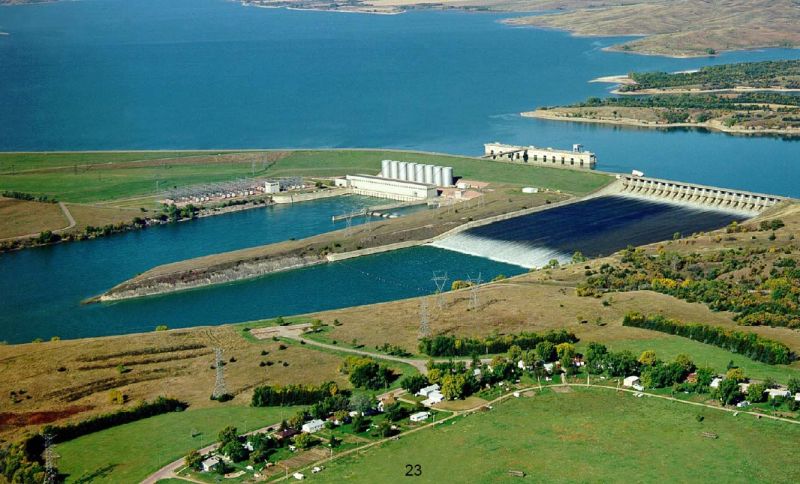
 Water and wastewater utilities across the country face common challenges. These include rising costs, aging infrastructure, increasingly stringent regulatory requirements, population changes, and a rapidly changing workforce. While many utilities find themselves turning from one urgent priority to the next, others have implemented effective operational efficiency initiatives that have helped them enhance the stewardship of their infrastructure, improve performance in many critical areas, and respond to current and future demands. Improved efficiency is not just beneficial to a utility’s bottom line – it benefits everyone in a community.
 A common problem facing many utilities today is a retiring work force. By implementing operational efficiency now, utilities can recruit and retain a workforce that is competent, adaptive, and correctly trained to take on leadership roles of their own. Through communication and effective training, utility owners and operators can create an organization focused on continual learning and improvement. This ensures employee knowledge is retained and improved upon. Over time, senior knowledge and best practices will be passed along to promote a well-coordinated senior leadership team who understands their system and the needs of its customers.
 Some practices that utilities are implementing greatly help to improve resiliency and reduce vulnerability to an ever changing climate. Internal practices and initiatives such as energy conservation, solar energy, and utilizing heat transformed into energy from sewage and digestion have helped utilities rely less on the grid and more on their own operations. This is especially beneficial considering the ever-increasing price of energy. Reducing energy use significantly lowers operational costs for utilities – freeing up dollars for future initiatives or infrastructure improvements. Utilities who practice operational efficiency understand that making internal practices more efficient results in the entire distribution system becoming more efficient.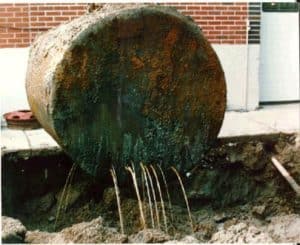

 In honor of International Beer Day, we are taking a look at what breweries are doing to conserve the number one ingredient in brewing beer: water. Due to water shortages, increased demand, and heightened awareness, many breweries have taken steps to increase water efficiency and to implement water saving techniques in their brewing. Utilizing a myriad of methodologies and technologies, an increasing number of today’s breweries have begun to focus on brewing beer with water efficiency and conservation at the forefront of their business.
 The undisputed behemoth of the beer world with 25% of the global beer market, Anheuser-Busch InBev has implemented water-saving measures in many ways. Some of its plants use reclaimed water for equipment cleaning, irrigation, firefighting, and other local uses, such as watering a soccer field in Peru and manufacturing bricks in Brazil. And, as would be expected from such an enormous, influential company, Anheuser-Busch InBev is piloting agricultural programs that it hopes will spread to all facets of agriculture. To start, they have initiated a “Smart Barley” program with 2,000 barley growers in Idaho and Montana. Since agriculture accounts for 95% of the water used in beer making, increasing agricultural water efficiency is the key to breweries becoming better water stewards. Utilizing sensors in the field, cooperative programs, and its own hybridized, drought-resistant seeds, Anheuser-Busch InBev hopes to decrease agricultural water usage by 25% over the next two years.
 Oregon-based

 distribution systems. Water audits are a vital step toward reducing lost water while improving water infrastructure. We lose billions of dollars every year to NRW — money that could be used to improve our infrastructure or to support other clean water initiatives. Water lost is water and money wasted, and the less NRW a utility has, the better off it — and its customers — will be.
 Recently in the news, we have heard a lot about the nationwide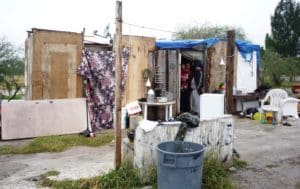
 Fortunately, Texas passed the Colonias Fair Land Sales Act in 1995 to somewhat protect colonia residents who are forced to finance through a contract for deed. The Act requires developers to record the contract with the county clerk and to provide property owners with an annual statement that shows the amount paid towards the loan and taxes as well as the number of remaining payments. The Act also forces developers to itemize which services, such as water, wastewater, and electricity, are available, and whether the land is located in a flood plain.